
Frontier Sciences
Ryutaro Yoshimi
Topological Quantum Materials Realized by Molecular Beam Epitaxy

Recently, researchers working in the field of condensed matter physics have discovered a class of materials that uniquely conduct electrical current at the surface but remain insulating in the bulk. These materials are called “topological insulators,” and their existence was revealed through the mathematical concept of topology.
Ryutaro Yoshimi
Associate Professor
Division of Transdisciplinary Sciences
Department of Advance Materials Science, Optical Science Course
https://www.k.u-tokyo.ac.jp/materials/en/yoshimi/
Topology is a branch of mathematics that studies the shapes of objects through continuous deformations, focusing on their overall structure. For example, although a donut and a coffee cup may appear to have different shapes, they both have the same structure in that they have a single hole. Further, they can be transformed into each other via smooth deformation. Over the past two decades, research has advanced rapidly as the deep connection between topology, quantum mechanics, and condensed matter physics has come to light, culminating in the 2016 Nobel Prize in physics for pioneering theoretical work in the field. Topological insulators, owing to their peculiar properties, have greatly advanced research in topological materials.
Beyond topological insulators, diverse materials—collectively known as topological quantum materials—have been discovered. These materials are garnering significant interest as candidates for next-generation electronic technologies. Conventional semiconductor technology has evolved dramatically in accordance with Moore’s Law. However, to further improve performance in the future, it is necessary to develop new devices with operating mechanisms that differ from existing principles. One of the leading candidates is topological quantum matter.
In our laboratory, we fabricate thin-film samples of topological quantum materials using a highly precise growth technique known as molecular beam epitaxy (Fig. 1).

Fig. 1 molecular beam epitaxy
Our research focuses on uncovering novel physical properties that emerge from these materials. Using thin-film samples makes it possible to observe and control the surface state. Furthermore, stacking different materials to form heterointerfaces allows to freely manipulate two-dimensional electronic states. In our previous work, we successfully observed the quantum anomalous Hall effect in magnetic proximity heterostructures consisting of stacked topological insulators and ferromagnets. The quantum anomalous Hall effect is a phenomenon in which the surface states of a topological insulator exhibit ferromagnetic interactions, leading to the emergence of dissipation-less currents. Traditionally, this phenomenon has been achieved by doping magnetic elements directly into the material. However, we successfully realized the quantum anomalous Hall effect via the magnetic proximity effect—for the first time globally—through a novel method that stacks a ferromagnetic insulator thin film onto a topological insulator (Fig. 2).

Fig. 2
Schematic of the magnetic proximity effect in a stacked structure of a topological insulator and a ferromagnetic insulator.
This approach expands the available options for magnetic layers and is expected to lead to the realization of the effect at high temperatures. The magnetic layer and the topological insulator layer can be spatially separated, enabling the development of functional quantum responses such as spin control using topological surface states. The engineered topological quantum material, although distinct from conventional topological insulators, enabled the experimental control of magnetization. This control resulted from the strong spin polarization of conduction electrons, which allowed the magnetization direction to be reversed by applying an electric current (Fig. 3).
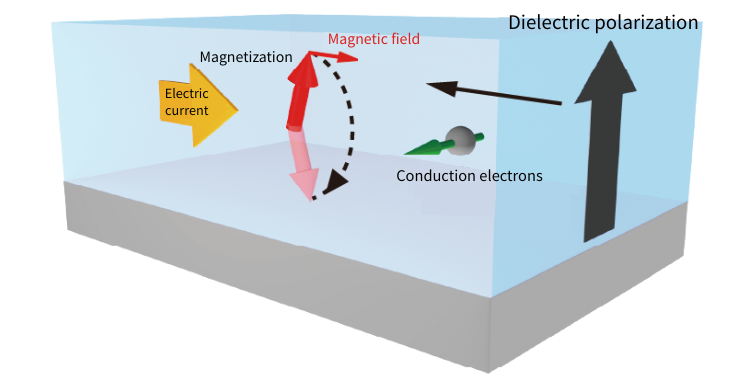
Fig. 3
Schematic of current-induced magnetization reversal achieved via the spin polarization of conduction electrons. In materials with dielectric polarization, the spin directions of conduction electrons are aligned. The interaction of the spin with the magnetization of the magnetic material makes it possible to change the direction of magnetization by applying an electric current.
Currently, research on topological quantum materials is progressing rapidly. Further, topological insulators as well as various new topological phases are being discovered one after another.
We will continue to realize new functional quantum properties that respond to electric and magnetic fields by precisely designing heterointerfaces using molecular beam epitaxy, which will lead to the development of next-generation quantum devices.

vol.46
- cover
- Fusion Energy
- Discussion Meeting
- Research Examples at the Transdisciplinary Fusion Energy Center
- Topological Quantum Materials Realized by Molecular Beam Epitaxy
- Small Symbiosis, Big Impact
- Life of Fish Roaming in the Vast Ocean
- GSFS Front Runners: Interview with an Entrepreneur
- Voices from International Students
- On Campus/Off Campus
- Events & Topics
- Awords
- Information
- Relay Essay