
Frontier Sciences
Takashi Kitagawa
Life of Fish Roaming in the Vast Ocean

Among Japan’s important fishery resources are fish species that migrate widely beyond Japan’s exclusive economic zone. There are still many unknowns, such as why these fish migrate on a large scale and when they begin their migration. In recent years, global warming seems to have changed the distribution range of fish. Our team investigates the migratory behavior and physiological state of tuna, salmon, and other fish species using various methods to clarify factors that affect their behavior and the process of adaptive evolution as well as to predict their future distribution.
Takashi Kitagawa
Professor
Division of Environmental Studies
Department of Natural Environmental Studies, Marine Environmental Studies Course
https://kitagawa-lab.jp/
A method called “biologging” is used to study the migration, behavior, and physiological state of fish. This method involves attaching small recorders or ultrasonic transmitters to living organisms to record behavioral and physiological information that cannot be directly measured by humans, along with environmental information. With the diversification of sensors and an increase in the data collection capacity, it has become possible to measure movement information such as fish speed and acceleration; environmental information such as illumination and geomagnetism; and physiological information such as still and moving images, body temperature, and heart and muscle potentials.
We were the first in the world to apply biologging to the study of bluefin tuna ecology. By clarifying environmental changes and their effects on individuals at various spatiotemporal scales, we provided information on the actual state and significance of migratory behavior and the process of adaptive evolution in the fish habitat. Currently, we are working on a project to identify the navigation methods that enable bluefin tuna and salmon to migrate (what landmarks they use to migrate) and develop technology to assess these methods.
Extensive migration requires a large amount of energy. Interestingly, tuna have a body temperature higher than the surrounding water temperature; hence, they require even more energy to maintain their body temperature. After hatching, juvenile salmon individuals must actively migrate from rivers along the Japanese coast to the open ocean, eventually reaching the Bering Sea, where they begin feeding. Conversely, when they reach adulthood, they return to their natal rivers to spawn, migrating upstream against the current. We are also examining the energy demands of fish migration, thermoregulation, and upstream movement using respiration-measuring tanks (stamina tunnels) and mathematical modeling. Salmon migrate up the Tone river, which flows near the Kashiwa Campus. By clarifying the characteristics of salmon in the Tone river, which is considered the southernmost river on the Pacific coast, we hope to understand the actual response of salmon to global warming.
The bodies of newly hatched fish, including tuna, are too small to allow for the application of biologging techniques in migration studies. For this reason, we utilize information within the fish’s body. By analyzing oxygen, carbon, and nitrogen isotopes in otoliths (calcium carbonate crystals in the head), eye lenses, and muscle tissues, we reconstruct the environmental conditions the fish experience. In particular, we demonstrate that the stable oxygen isotope ratio in the otoliths of bluefin tuna larvae functions as an effective thermometer, accurately reflecting the water temperatures they experience. The survival rate immediately after birth determines the amount of resources available that year. By aligning empirical water temperatures derived from stable oxygen isotope ratios with marine environmental data, we can trace the migratory paths of fish from birth and identify the optimal growth environments for these resources.
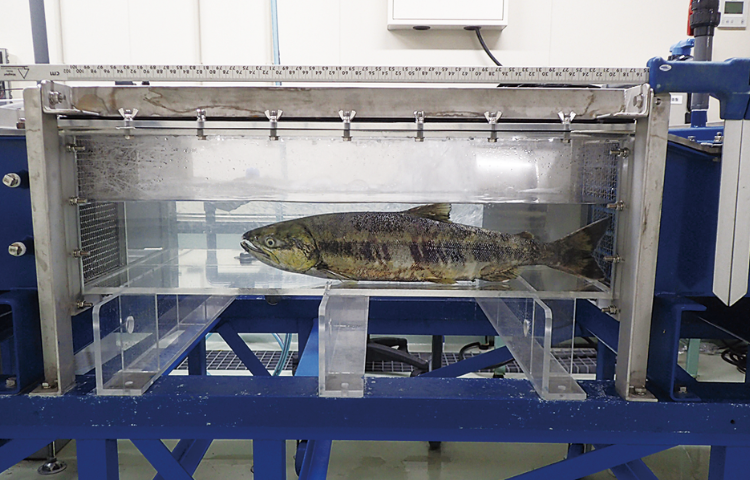
A tank used for measuring respiration data (stamina tunnel) and salmon housed therein.

A juvenile bluefin tuna with an electronic data logger (archival tag) on the ventral side and a tag on the dorsal side.

Archival tag. The main body measures water pressure (depth) and body temperature, and the cable measures water temperature and light intensity.

Microscopic image of a bluefin tuna otolith.

vol.46
- cover
- Fusion Energy
- Discussion Meeting
- Research Examples at the Transdisciplinary Fusion Energy Center
- Topological Quantum Materials Realized by Molecular Beam Epitaxy
- Small Symbiosis, Big Impact
- Life of Fish Roaming in the Vast Ocean
- GSFS Front Runners: Interview with an Entrepreneur
- Voices from International Students
- On Campus/Off Campus
- Events & Topics
- Awords
- Information
- Relay Essay