
A column introducing and supporting student activities
Kashiwa-no-hatake: Cultivating a Regenerative Future Through Co-Creation

Hatake*× Art × Science: An Open Experimental Hub Run by Students
The small Kashiwa-no-hatake1, tucked behind the Bioscience Building at the Graduate School of Frontier Sciences, has been managed by successive generations of faculty, staff, and student volunteers since the Kashiwa Campus was established. Recently, it was revitalized through a student-led project called Kashiwa-no-hatake, cultivating not only crops but also community, creativity, and a renewed connection with the earth.
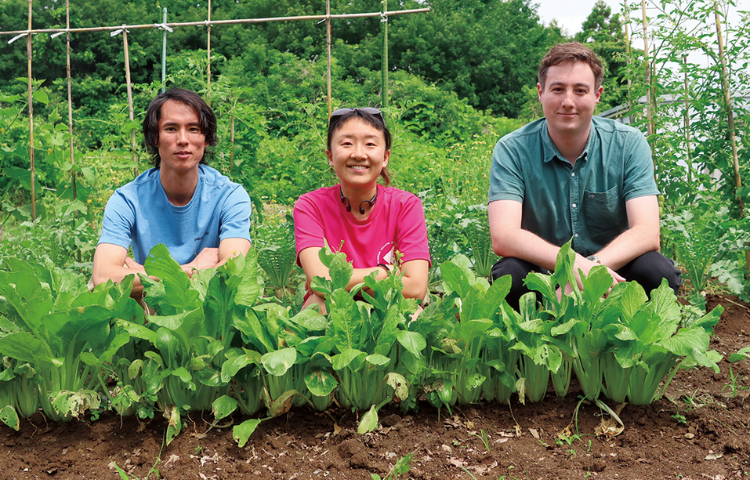
The project members include graduate students in the Sustainability Science program as well as students from other departments. Chris, the project representative, together with co-founders Miya and Yuichi, leads the group, which currently consists of eight members. The team believes that escalating crises such as climate change and biodiversity loss arise partly from weakening bonds between human society, other living beings, and the natural world. This project was born from a desire to restore those connections.
Chris said, “Our members come from diverse countries and fields of expertise. We want to transform the field into more than just a place to grow produce; we aim to make it a hub for events, art, and learning, expanding connections with nature and people.” Yuichi adds, “Degrowth is also a theme. As the negative impacts of economic growth on the Earth become increasingly apparent, I hope we can pursue experimental initiatives that enhance people’s lives without relying on further economic expansion.” Miya, from the Graduate School of Arts and Sciences, who coordinates activities within and outside the project, said, “We aim to put into practice ideas like a circular economy by using items currently discarded as waste—such as abalone shells—as materials for farm fertilizers and art.”
This project has just begun. In the future, the group plans to deepen their knowledge by conducting fieldwork and undertaking various activities, including ongoing maintenance of the field, workshops, musical events, and BioBlitzes.
*Hatake: Japanese term for a cultivated field—a place where people grow vegetables, grains, and other crops, often close to homes or within local communities.
Interviewed and written by Mayuko Araragi
The activity is partially funded by the school’s “Student Creation Project.”
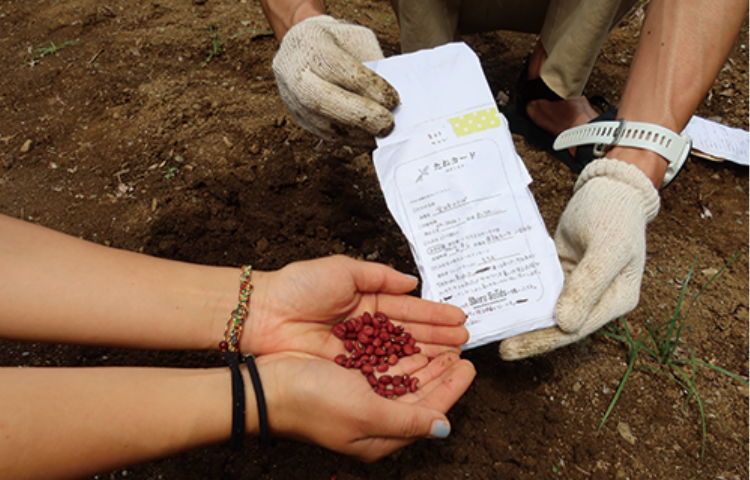
Utilizing seed banks where seeds are borrowed for cultivation and returned after harvest
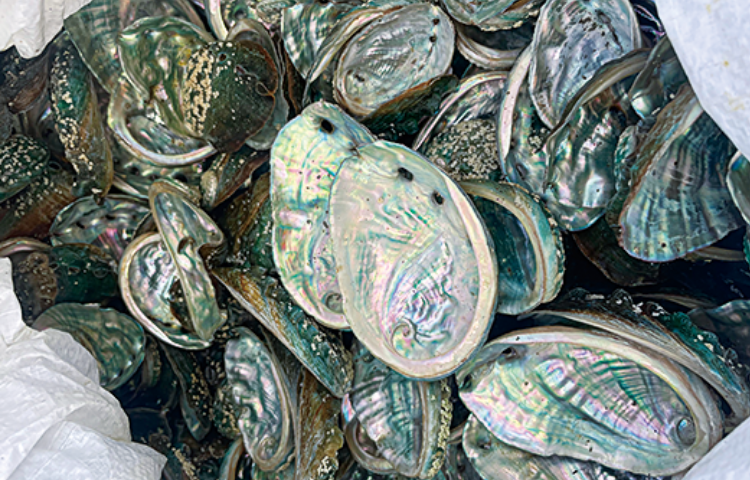
Discarded abalone shells are now being used as fertilizers and art pieces
Kashiwa Campus Science Camp
https://ksc.edu.k.u-tokyo.ac.jp/
The 10th program of Kashiwa campus science camp took place in 2024, with the Kavli Institute for the Physics and Mathematics of the Universe and the Sustainable Social Design Center joining as new participants. In total, 42 laboratories from the graduate school and its affiliated research institutes offered classes during February and March. Further, for the first time, the program was conducted in English. Notably, 149 students from the Junior Division of the Graduate School of Arts and Sciences participated in the four-day in-person training. The students commented that the program “increased their focus on research,” “enabled them to experience learning through self-directed information gathering,” and “helped them understand the importance of background knowledge and foundational skills.” Faculty members also praised the program, stating that it “allowed us to tackle new themes together” and provided “a valuable opportunity to experience laboratory research.”
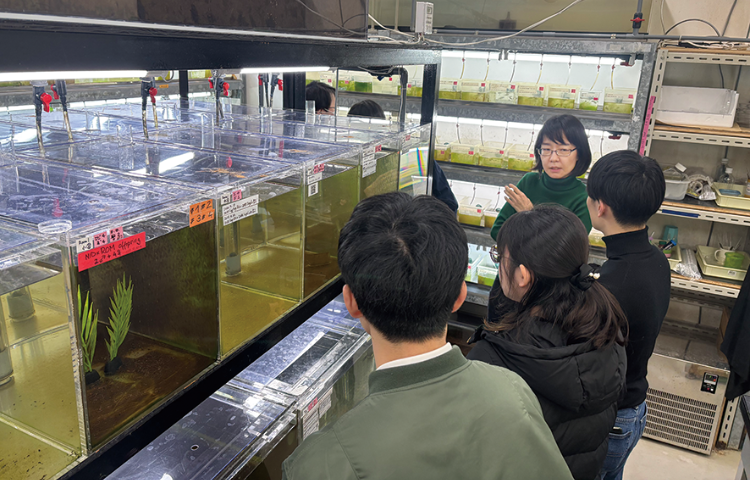
Program: “Molecular Genetic Mechanisms of Adaptive Evolution Explored Using Spiny Fish”; Ishikawa Laboratory
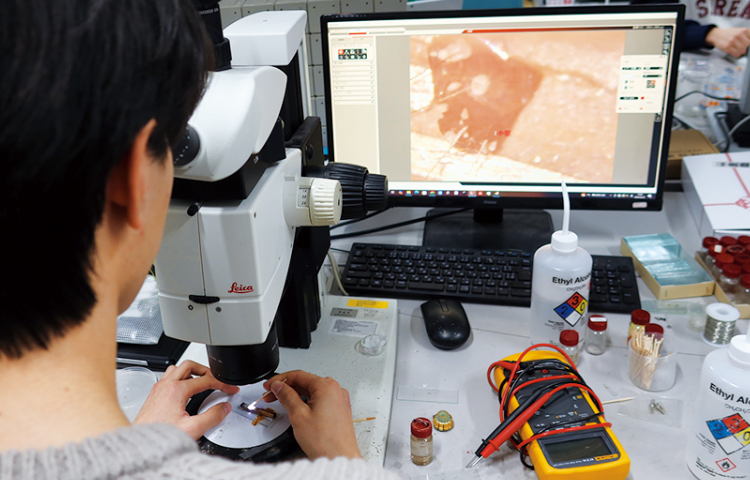
Program: “Exploring the World of Quantum Properties Through Superconductivity”; Shibauchi & Hashimoto Laboratory
vol.46
- cover
- Fusion Energy
- Discussion Meeting
- Research Examples at the Transdisciplinary Fusion Energy Center
- Topological Quantum Materials Realized by Molecular Beam Epitaxy
- Small Symbiosis, Big Impact
- Life of Fish Roaming in the Vast Ocean
- GSFS Front Runners: Interview with an Entrepreneur
- Voices from International Students
- On Campus/Off Campus
- Events & Topics
- Awords
- Information
- Relay Essay