
Research Examples at the Transdisciplinary Fusion Energy Center
The Transdisciplinary Fusion Energy Center, which was established in April 2025, has 15 faculty members in four departments. It conducts a wide range of research activities. Some examples are provided below.
Core Miniaturization through Plasma Heating and Control Using Radiofrequency Waves
ーPlasma heating using radiofrequency waves
Naoto Tsujii
Associate Professor
Department of Complexity Science and Engineering
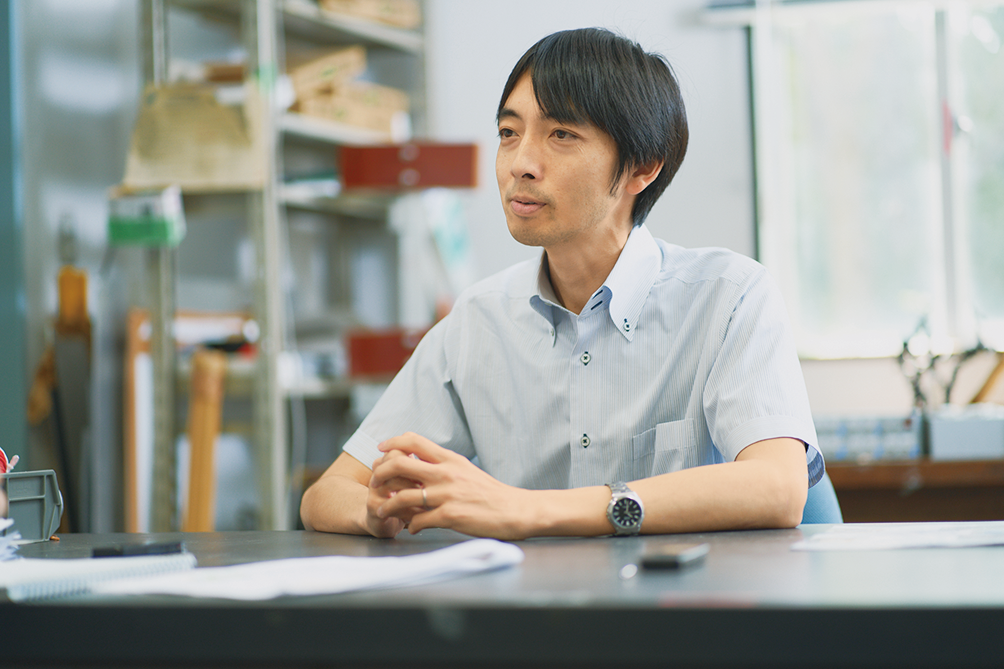
Currently, in tokamak reactors such as ITER, an electric current is driven through the plasma using an electromagnetic coil in the center of the reactor called the central solenoid (CS). Radio-frequency waves (or neutral particles) are then injected to heat the plasma to over 100 million degrees. Associate Professor Tsujii is engaged in experimental and simulation research on radio-frequency heating.
“One of the themes is to use radiofrequency waves to control the distribution of plasma currents and discover a more ideal magnetic field configuration. Therefore, we will use TST-2 (a small spherical tokamak device) at GSFS to repeat the process from physics design to device design, manufacturing, installation, and experimentation over a span of about one year. Our basic research style is to conduct modeling and simulations based on experimental results.”
Compared to large-scale experiments, which require several years for installation of heating equipment, this is a suitable method for verifying various ideas. Associate Professor Tsujii is also currently considering the miniaturization of the CS.
“The CS is very powerful and commonly used in tokamak reactors. However, when considering the steady-state operation of the DEMO reactor, we believe that miniaturizing the CS is the key. Following the experiment of TST-2, we plan to demonstrate new ideas in JT-60SA. If all goes well, I think we may be able to find a solution that will achieve dramatic improvements in performance.”
Research into elemental technologies, led by Japan, is now underway here as well.
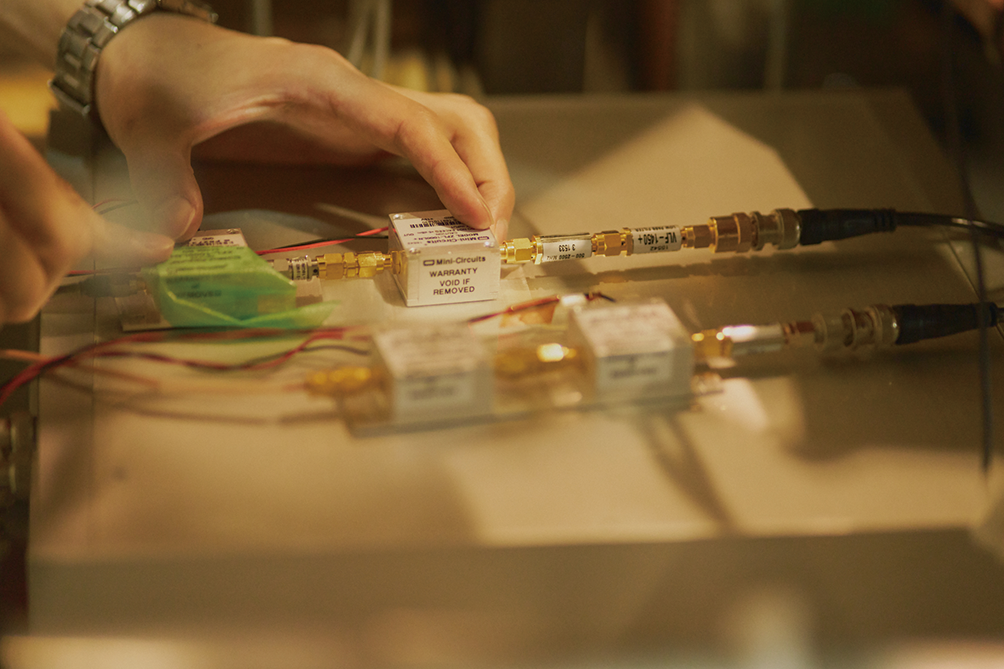
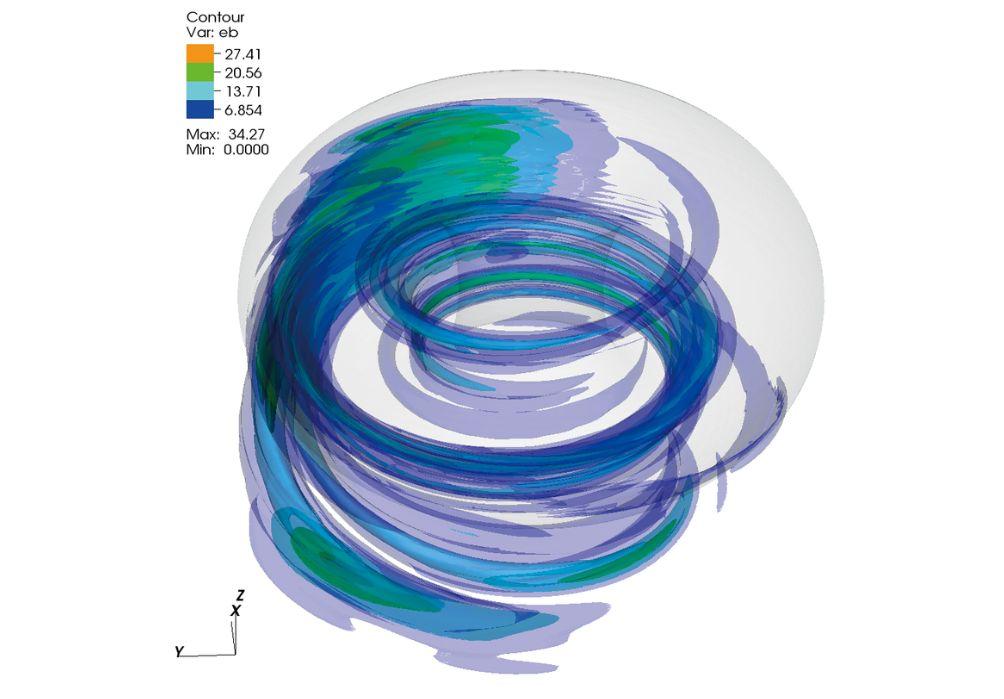
Electric field distribution of plasma waves in TST-2 calculated numerically
Addressing Plasma Heat Removal Essential for Realizing a Compact DEMO Reactor
ーDivertor
Yuki Hayashi
Assistant Professor
Department of Complexity Science and Engineering
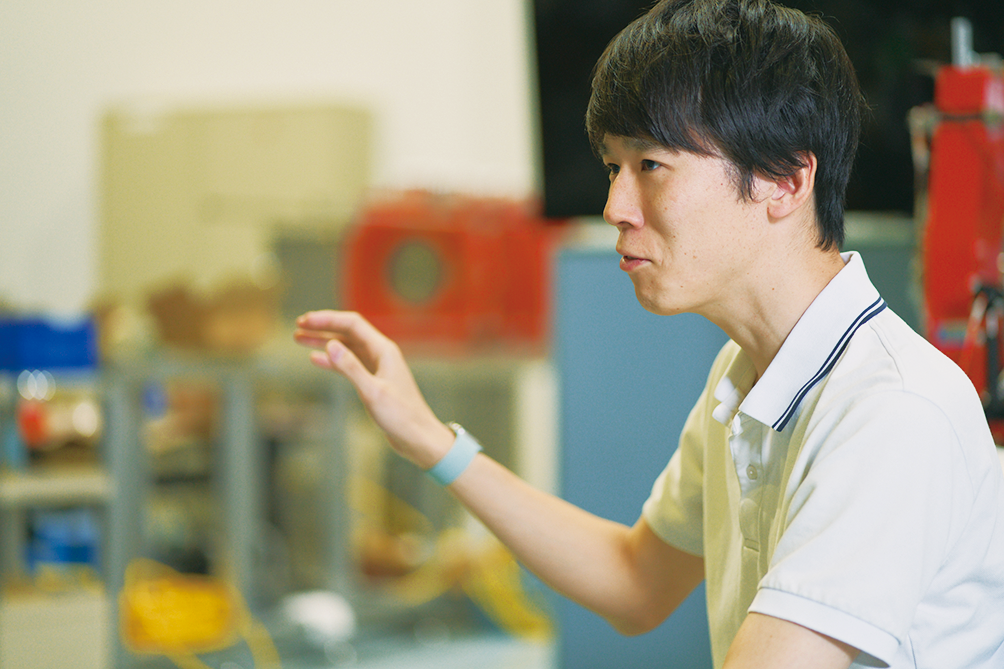
A divertor is a device used for the efficient extraction of helium ash generated in the plasma within the reactor. Since high-energy ions are concentrated in the divertor, extremely high heat resistance is required. Hence, tungsten, with a melting point exceeding 3000°C, is used.
“While the ion heat flow expected in the DEMO reactor will be several times greater than that in ITER, the size of the device will not change significantly. Therefore, a method is being considered in which a neutral gas is blown into the plasma to revert it to the gas state, removing ~90% of the thermal energy. The plasma generated in this process is called detached plasma, and it is the main topic of my research.”
Assistant Professor Hayashi is currently investigating how to manage the intermittent plasma emission phenomenon known as the edge localized mode (ELM), an unavoidable challenge in tokamak-type fusion devices. If the ELM occurs in a normal plasma, there is a high risk of adverse effects on the divertor.
“Even if we can create detached plasma and extinguish normal plasma, there is a possibility that if the ELM occurs, the detached plasma will be destroyed and the divertor will melt. I think research is needed on detached plasma, which will also prove beneficial for ELM mitigation, or on the divertor structure and innovative ways of blowing the neutral gas. However, the DEMO reactor is an unknown territory and direct experiments are not possible. We’re currently extrapolating data from experimental equipment in Japan and abroad into simulations, aiming to clarify underlying processes from atomic and molecular perspectives.”
Assistant Professor Hayashi’s goal is to lead the world in research on detached plasma for ELM mitigation.

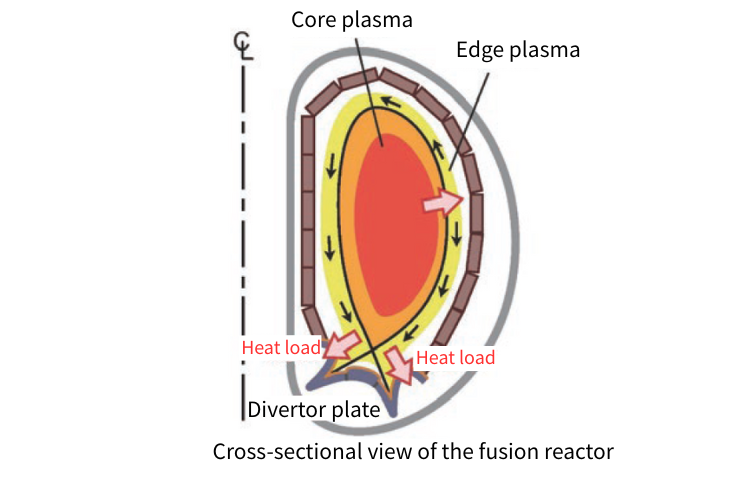
Helium ash ions generated by fusion reactions in the core plasma flow into the divertor and are subsequently exhausted from the reactor.
Human Resource Cultivation Under the Nuclear Fusion Research Education Program is Now in its 17th Year
The Graduate School of Frontier Sciences’ Nuclear Fusion Research Education Program has been operating since 2008, with a curriculum system that spans the Department of Advanced Energy and the Department of Complexity Science and Engineering. As of 2024, a total of 162 master’s degree students and 21 doctorate degree students have completed the program. We interviewed three of them about what they learned in the program and what they are doing now.
Working on Challenges while Absorbing Knowledge and Ideas from Different Fields

Shuji Kamio
Project Scientist
Department of Physics and Astronomy
University of California, Irvine
In 2008, I entered the Graduate School of Frontier Sciences and participated in the Nuclear Fusion Research Education Program as a first-year student. In addition to lectures, I participated in various laboratory training sessions, which greatly broadened my horizons. During my time at the university, I was immersed in my daily research. Looking back now, I believe I developed an approach to tackling problems that involved absorbing knowledge and perspectives from highly diverse fields.
I am currently affiliated with the Department of Physics and Astronomy at the University of California, Irvine, where I am engaged in research on next-generation fusion reactors. The research utilizes the field-reversed configuration (FRC) device developed by TAE Technologies, and I am responsible for the development and operation of plasma diagnostics. As a member of the experimental group, I repeatedly operate and observe plasma and study the interaction between high-speed ions and waves. The goal is to improve confinement performance and establish stable operating conditions by improving the device and upgrading analytical methods.
I would like to contribute to my own research theme and field—waves and plasma particles—while hoping to make a small contribution toward the realization of nuclear fusion reactors.
Insight and Project Leadership in Engineering: Understanding the Full Process from Concept to Delivery
Hirokazu Furui
Engineer, Hitachi, Ltd.
Infrastructure Control System Division
Omika Works
Power Grid Control Systems Engineering Department,Power Generation Control Systems Division
One of the most memorable experiences I had as a student was making my own small Rogowski coil to measure the current density profile in plasmas. It initially took a week to wind a thin wire 300 turns around a 2-cm-diameter ring, but through trial and error—cutting resin to shape the core and using programming to optimize the winding method—I found a far more efficient approach. I had a lot of fun attaching my homemade coil to the device (TST-2), conducting experiments, and presenting the results at conferences in Japan and abroad. Thus, I was able to immerse myself in my research.
Currently, I am responsible for the design, development, and commercialization of a DC high-speed vacuum circuit breaker board for electric railway substations. Because this product is a system, we had to manage and execute the project in collaboration with multiple departments to advance it successfully. I feel that the ability to understand and proceed with the entire manufacturing process, from upstream to delivery, that I cultivated by working in this new field has been useful.
In the future, I aim to become an engineer who can contribute to the public good in an increasingly competitive market, working closely with many people.
Research Incorporating Data-Driven Methods Leads to Further Results

Tatsuya Yokoyama
Researcher
Naka Institute for Fusion Science and Technology
National Institutes for Quantum Science and Technology
In this program, students gained a comprehensive understanding of nuclear fusion plasma physics not only through theoretical study but also via hands-on training with experimental equipment and simulation codes in each laboratory. One thing I remember most is the practical training in which students discussed various topics with each other. Not only did this training help students logically organize and express their own thoughts and understand the thoughts of others but also deepen friendships among the students.
I am currently involved in plasma experiments on JT-60SA, the world’s largest superconducting tokamak. The main research themes are disruption phenomena, in which plasma confinement suddenly collapses and thermal and electromagnetic energies are lost, and magnetohydrodynamic (MHD) instabilities, which are the primary cause of these disruptions. Disruption phenomena can inflict extreme damage on internal reactor components and magnetic confinement coils, making their understanding and control a critical challenge in advancing the DEMO reactor. To analyze experimental data, I will leverage my strengths in data-driven approaches, including machine learning, AI, and statistical methods. I hope to achieve results that contribute to the future of fusion energy.
Nuclear Fusion Research Education Program
The program is based on two pillars: (i) a transdisciplinary education curriculum, which allows students to comprehensively and systematically learn diverse basic academic subjects that cross the fields of departments of advanced energy and complexity science and engineering, and (ii) an advanced and exciting practical research education curriculum, which is based on cutting-edge research projects. Students study diverse fields in an interdisciplinary and comprehensive manner, including plasma science and engineering, nuclear fusion science, and even the environment and society.
https://www.k.u-tokyo.ac.jp/fusion-pro/en/
Conclusion
The fusion energy landscape is now beginning to change dramatically. The Graduate School of Frontier Sciences’ Transdisciplinary Fusion Energy Center, Social Collaboration Course on Fusion System Design, and Nuclear Fusion Research Education Program will play extremely important roles such that Japan can lead the world in further advancement of core technologies, design of the DEMO reactor, and industrialization of the supply chain.
Reporting, editing, and writing by Kazutada Furui
vol.46
- cover
- Fusion Energy
- Discussion Meeting
- Research Examples at the Transdisciplinary Fusion Energy Center
- Topological Quantum Materials Realized by Molecular Beam Epitaxy
- Small Symbiosis, Big Impact
- Life of Fish Roaming in the Vast Ocean
- GSFS Front Runners: Interview with an Entrepreneur
- Voices from International Students
- On Campus/Off Campus
- Events & Topics
- Awords
- Information
- Relay Essay