
FRONTIER SCIENCES
Tsubasa Kodaira
Confronting the Rapid Sea Ice Loss in Polar Regions

When one thinks of the Arctic, polar bears come to mind, for Antarctica, penguins. We study the polar oceans and sea ice, which seem familiar and yet remain distant from our daily lives. One of my research interests has been the melting of sea ice in the Arctic Ocean. The Arctic Ocean is drawing increasing attention as an important region that is already showing the effects of global climate change, particularly through reductions in summer sea ice extent. Interest is also growing in a new shipping route known as the “Arctic Sea Route.”
Tsubasa Kodaira
Lecturer
Division of Environmental Studies
Department of Ocean Technology, Policy, and Environment, Applied Physical Oceanography
https://www.k.u-tokyo.ac.jp/en/gsfs/faculty/tsubasa_kodaira/
Compared to the existing major shipping routes connecting Europe and East Asia (via the Strait of Malacca and the Suez Canal), the Arctic Sea Route offers potential advantages such as shorter travel distances and reduced exposure to piracy-prone or geopolitically unstable areas. As sea ice decreases due to global warming, it is also expected to become a new route for general merchant vessels, contributing to lower carbon emissions. However, risks remain, including hull damage caused by sea ice and delays due to route changes. Therefore, safe and planned navigation requires an accurate understanding and prediction of sea ice conditions.
Despite major advances in ocean observation technology, it remains difficult to observe and understand the polar oceans. The temperature and salinity structure of the world’s oceans are monitored through international cooperation by more than 4,000 autonomous profiling floats, commonly known as Argo floats. However, in polar regions, sea ice prevents the floats from surfacing to transmit their data, creating major gaps in observational coverage.
In addition to the challenges of understanding the current state of the Arctic sea ice through observation, there are also challenges in understanding the physical processes by which Arctic sea ice is changing. In particular, the transition zone between sea ice-covered and sea ice-free waters, known as the marginal ice zone, plays an important role in sea ice growth and melting, yet is known to be highly complex and characterized by substantial uncertainty. In October 2019, I first visited the marginal ice zone of the Arctic Ocean aboard the Research Vessel Mirai operated by the Japan Agency for Marine-Earth Science and Technology (JAMSTEC). The constantly changing conditions of snow, wind, ocean waves, and sea ice made the experience of observing and recording these phenomena intense and invaluable.
Although I had long understood through my research and my visit to the Arctic Ocean that sea ice melts, I truly felt its reality during the sea ice observations I recently participated in as part of the 66th Japanese Antarctic Research Expedition, under the general research observation project (Project Leader: Takuji Waseda, University of Tokyo). When the icebreaker “Shirase” arrived near Showa Station at the end of 2024, the sea ice that covered a wide area of the ocean melted rapidly during the approximately one month spent there. Although this may be an exaggeration, observing from above how the sea ice barely covered the ocean made me feel that even the vast polar ice fields might eventually disappear, highlighting how delicately the Earth’s climate is balanced.
While the loss of sea ice, particularly in the Arctic, is a well-established observational fact, our understanding of the fundamental questions of why and how sea ice melts remains incomplete. The ocean is thought to be an important heat source, but the processes of heat transport leading to sea ice melt are not fully understood. Sea ice melting is believed to be closely linked to the mechanical deformation of ice, but knowledge in this area remains limited. A better understanding of the complex mechanisms of sea ice fluctuations will allow more accurate predictions of sea ice distribution, leading to safer and more efficient use of Arctic shipping routes. We are further developing the compact ocean observation instruments that we have worked on over the years, while also integrating field measurements, satellite observations, and numerical models to clarify the mechanisms of sea ice melt and improve predictions of sea ice conditions.

Measuring ice thickness and related parameters in Lützow-Holm Bay near Showa Station, Antarctica, where observation buoys are set up on sea ice.

Top photo: Sea ice observation activities in Lützow-Holm Bay, Antarctica, viewed from a drone. Bottom photo: Actively melting sea ice in Lützow-Holm Bay, photographed from an expedition helicopter. The sea is visible through gaps in the ice.

The author during his first visit to the marginal ice zone of the Arctic Ocean. Newly formed sea ice spreads across the surface, creating a fantastical sight on the ocean surface.
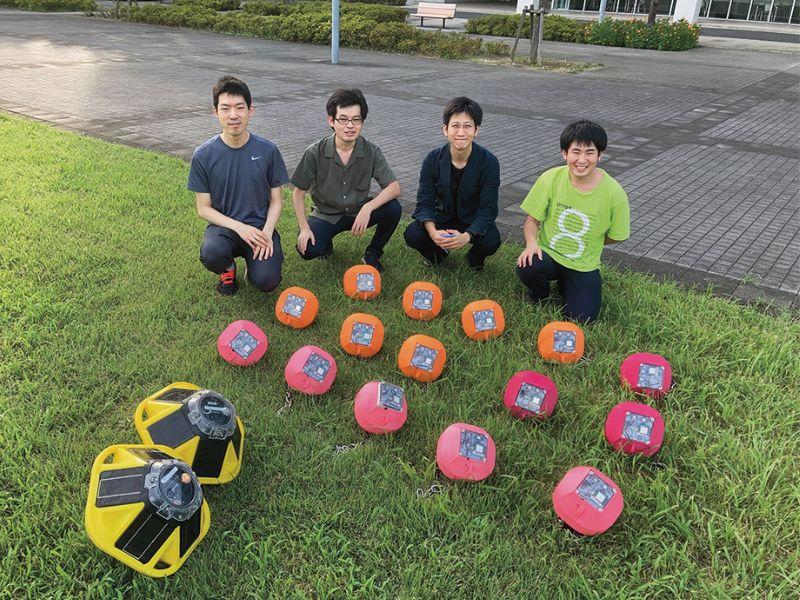
A set of wave buoys manufactured and prepared in 2022 for the Arctic observation cruise of the Mirai research vessel operated by JAMSTEC.

vol.47
- cover
- Floating Offshore Wind Power: Paving the Way for the Future
- Toward the Practical Application of Floating Offshore Wind Power
- Examples of Research on Floating Offshore Wind Power in the Graduate School of Frontier Sciences
- Exploring the Interaction between Plasma and Materials: From Nuclear Fusion to the Creation of Functional Materials
- New Information Science and Machine Learning for Deciphering Life
- Confronting the Rapid Sea Ice Loss in Polar Regions