
2. Toward the Practical Application of Floating Offshore Wind Power
In offshore wind power, Europe and China are currently leading in both technological development and industrial deployment of fixed-bottom systems. In contrast, floating offshore wind power is a field where various countries are competing in research and development, presenting a significant opportunity for Japan. Achieving the goal of 15 GW by 2040 depends on collaboration between academic disciplines, industry and academia, and international collaboration. This section presents a discussion among three researchers on the initiatives being undertaken at The University of Tokyo, centered on UT-FloWIND, and future directions.

Chairman
Shinichiro Hirabayashi
Associate Professor, Department of Ocean Technology, Policy, and Environment,
Graduate School of Frontier Sciences
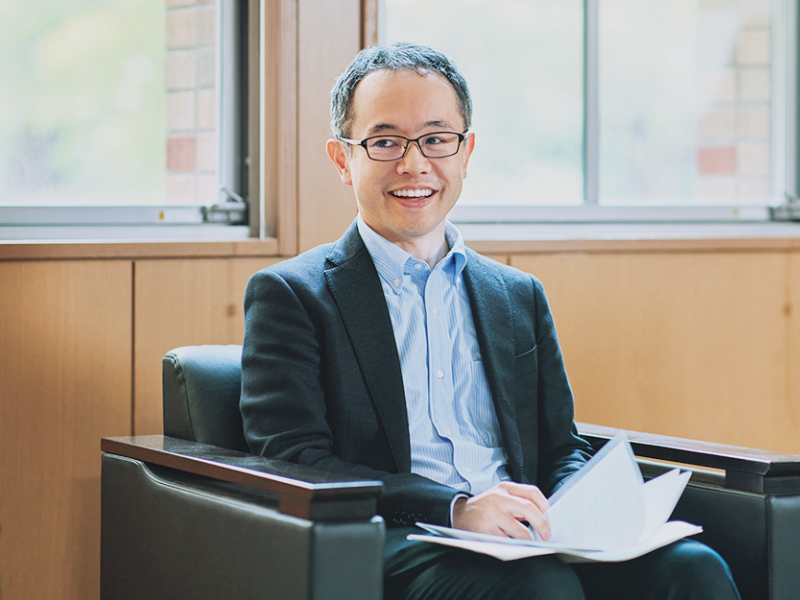
Hirabayashi: First of all, please introduce the research themes you are currently working on in relation to floating offshore wind power.
Yuka Kikuchi
Lecturer, Department of Civil Engineering,
Graduate School of Engineering

Kikuchi: My current research focuses on the motion analysis of floating offshore wind power systems from the perspective of wind engineering as a subfield of civil engineering. I am working on the development of floating platform shapes and optimal turbine control strategies to reduce platform motion and wind turbine loads. In addition to design aspects, I am also developing cost models to clarify how construction and maintenance methods influence the levelized cost of energy for wind power.
Toshihiro Maki
Associate Professor,
Institute of Industrial Science
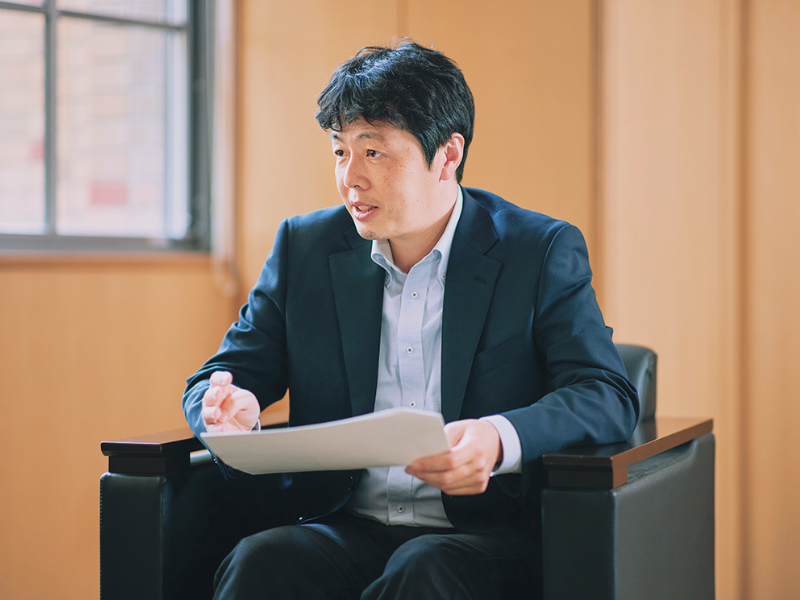
Maki: My research focuses on unmanned underwater exploration systems, particularly autonomous underwater vehicles (AUVs). As the number of floating offshore wind installations increases, so does the need for maintenance and inspection. Therefore, I am conducting research on the use of fully autonomous robotic systems to efficiently and accurately inspect floating structures, mooring lines, and dynamic cables.
Kikuchi: Since floating offshore wind farms are located farther from the coast, improving maintenance efficiency is important. In a recent research project in which I was involved, we evaluated the extent to which maintenance costs could be reduced through the development and implementation of AUVs.
Hirabayashi: I specialize in floating structures, and my research focuses on predicting the motion of various types of floating platforms and identifying effective design approaches to suppress such motion. I am also collaborating with Professor Maki on monitoring technologies for mooring lines and dynamic cables. Monitoring objects in motion in the ocean is a challenging task.
Expanding Research Toward Practical Application of Floating Offshore Wind Systems
Hirabayashi: Next, please tell us what topics are currently being discussed as key areas for future research.
Maki: In offshore environments, maintenance costs tend to be higher than on land and have a substantial impact on power generation costs. Recently, in addition to AUVs, robots known as autonomous surface vehicles (ASVs) have attracted attention. It is becoming increasingly important to develop efficient inspection methods that combine ASVs with AUVs, remotely operated vehicles (ROVs), and drones.
Hirabayashi: So ASVs are used as a kind of base platform?
Maki: Yes. For example, radio waves cannot be used underwater, so AUVs cannot utilize GPS positioning or communicate directly with land. That is why ASVs are useful. They can perform acoustic positioning and communication with AUVs underwater, serving as position references and as communication relay stations. In the future, ASVs may also be capable of deploying and recovering AUVs.
Hirabayashi: Could floating platforms for offshore wind themselves be used as ASVs?
Maki: That is also possible. Floating platforms are equipped with GPS, have access to electrical power, and can host various sensors. From these platforms, it would be possible to provide positional guidance to AUVs, and even dock and recharge AUVs. Such systems could be operated autonomously.
Kikuchi: If such a system could be operated fully autonomously, it would be the world’s most advanced offshore wind farm. On that note, my laboratory is also engaged in cutting‑edge research on wind‑turbine wake measurement, using a scanning lidar system to capture wind speeds across offshore wind farms at a scale that is unprecedented worldwide. The goal is to evaluate how downstream wind‑speed deficits influence the power output of neighboring turbines.
Hirabayashi: What is the scale of these measurements?
Kikuchi: The measurements are conducted several kilometers offshore, capturing wind speed distributions over an area approximately 100 m x 100 m, equivalent to the rotor diameter of a wind turbine. Since power generation directly affects project feasibility, establishing such measurement methods is essential.
Hirabayashi: From a broader perspective, I believe that constructing, deploying, and operating a large number of floating offshore wind turbines will open up an entirely new world. Technically, they are the same as drilling platforms in conventional offshore oil and gas fields, but those typically involve only a few to several dozen units. Floating offshore wind turbines must be installed by the hundreds over a period of several years to a dozen years, requiring technological breakthroughs. Moreover, during installation, floating turbines are subjected to waves, wind, and ocean currents, resulting in motion modes different from those during operation. How to deal with these conditions remains a key challenge.
Kikuchi: I agree that technologies for efficiently manufacturing and installing large numbers of floating offshore wind systems are important. Subsequent maintenance and eventual decommissioning also require technological development utilizing modeling and simulation.
Future Possibilities and Challenges
Hirabayashi: When you think about the future of floating offshore wind power, are there any things you hope to see happen?
Maki: Related to what I mentioned earlier, I envision floating offshore wind systems serving as frontline bases for ocean exploration. Wind turbines deployed across Japan’s EEZ could function as positioning references, communication relay stations, and energy supply hubs for numerous robots operating on the sea surface, underwater, and in the air. In such a scenario, data from the surrounding waters would be continuously collected and systematically organized.
Hirabayashi: I also see floating structures as platforms with a wide range of potential applications. For example, ship fuel is currently oil, but if ammonia or hydrogen could be produced using floating offshore wind systems, fuel stations could be established across the EEZ, enabling offshore bunkering (fuel supply to ships).
Kikuchi: I hope that the advancement of renewable energy technologies, including floating offshore wind power, will improve Japan’s energy self-sufficiency rate. According to data from the Ministry of Economy, Trade and Industry, Japan’s energy self-sufficiency rate was 12.6% in 2022, ranking 37th among 38 OECD countries. Despite being a maritime nation, Japan has not yet connected the ocean to energy. Establishing floating offshore wind power systems could represent a significant breakthrough in this regard.
Hirabayashi: In terms of energy self-sufficiency, electricity produced offshore must be transmitted to land, where it is consumed. This is both a key point and a challenge.
Kikuchi: Based on experience with overseas fixed-bottom offshore wind power systems, there is a risk of failures in transmission cables, making this a critical area for technological development. In Europe, there is a lot of discussion about technology to store wind power as hydrogen, and the use of gas pipelines for transport is also being considered.
Maki: Japan and Southeast Asia face severe marine conditions, such as typhoons. Offshore wind power systems are well established in Europe, but can those technologies be directly applied here?
Kikuchi: In the early 2000s, there were incidents in Japan where wind turbines imported from Europe collapsed due to typhoons. Therefore, a method for evaluating 50-year-recurrence wind speeds using typhoon models was established, leading to the development of domestic design guidelines and their incorporation into international standards. In fact, my graduate thesis was related to this topic. Today, accidents caused by typhoons have become less frequent.
Hirabayashi: However, a complicating factor is the possibility that typhoons may intensify further due to climate change. This is likely to become an important issue in the future.
The Role to be Played by UT-FloWIND
Hirabayashi: What are your expectations and aspirations for the future of the collaborative research organization (UT-FloWIND)?
Kikuchi: Countries around the world are currently competing to develop floating offshore wind power technology. It is important for Japan to stand up to this challenge through a unified, “All Japan” approach. Both industry and academia should bring out their strengths and act collectively and decisively. Establishing it as a large-scale industry quickly would be more economically viable and would allow Japan to take on a leading role globally.
Maki: From an industry perspective, UT-FloWIND serves as a valuable point of contact for consulting with The University of Tokyo on research related to floating offshore wind power, and I hope it will be actively and widely utilized. Since so many researchers from various fields have gathered on campus, I think it would be great if we could set up our own floating wind turbine for experiments. Even a small-scale system would help reveal more specific challenges and potential solutions.
Hirabayashi: Indeed, having an easily accessible experimental marine field would be extremely valuable.
Kikuchi: In addition to technology, policy aspects such as the bidding system are also becoming important.
Hirabayashi: I am also involved in an internal organization called the Ocean Alliance Collaboration Research Organization, which includes researchers in public policy. Faculty members with an engineering background often tend to believe that technology can solve many problems. In contrast, the field of public policy approaches issues from a very different perspective, and its way of thinking and decision-making processes are both refreshing and thought-provoking. I feel that floating offshore wind power could be a catalyst for new forms of collaboration.
Kikuchi: From an educational perspective, wind energy is a cross-disciplinary technology. In Europe, there are specialized master’s programs in wind power generation that reflect this characteristic. I was particularly impressed by the fact that students can earn master’s degrees in two different fields over the course of three years by studying at two or more universities. Students also go to companies as interns. However, unlike internships in Japan that are primarily aimed at job hunting, these are research-oriented internships in which industry researchers actively participate in thesis guidance. Although these are examples from Europe, I hope that the establishment of this collaborative research organization will improve the atmosphere in this field in Japan as well.
Maki: Well, it is wind power after all (laughs).
Hirabayashi: You are absolutely right, and I believe it is an initiative that educational institutions like ours should take the lead in. Thank you very much for your time today.