Floating Offshore Wind Power: Paving the Way for the Future
In recent years, floating offshore wind power has attracted particular attention as a renewable energy source. While floating giant wind turbines on the sea have the potential to generate large amounts of electrical energy, there are many technical challenges regarding their installation and operation compared to bottom-fixed systems. As efforts to advance floating offshore wind power generation are accelerating across Japan, this article introduces initiatives undertaken by The University of Tokyo and the Graduate School of Frontier Sciences.
1. Current Status and Challenges of Floating Offshore Wind Power
2025 has been a major turning point for floating systems.
In 2020, the Government of Japan declared to the world its goal of achieving carbon neutrality (net zero greenhouse gas emissions) by 2050. Achieving this goal requires not only rigorous energy conservation but also the maximum possible deployment of renewable energy sources.
Professor Toru Sato, who specializes in marine technology and the environment, noted, “Offshore wind power is considered a key technology for making renewable energy a primary power source.” In Japan, due to its geographic conditions, there are strong expectations for floating offshore wind systems, and 2025 is emerging as a pivotal year for their full‑scale deployment.
First, in June 2025, the revised “Act on Promoting the Utilization of Sea Areas for the Development of Marine Renewable Energy Power Generation Facilities” was enacted, allowing the installation of offshore wind power generation facilities within Japan’s exclusive economic zone (EEZ). Previously limited to territorial waters, the development area has now been significantly expanded into the EEZ. In the EEZ, where the water depth exceeds 50 m, floating-type wind turbines are assumed to be the primary approach rather than fixed-bottom systems.
Subsequently, in August 2025, the “Vision for Offshore Wind Power Industry (Second Edition)” was presented by an expert panel of Japan’s Ministry of Economy, Trade and Industry (Offshore Wind Promotion Working Group). This vision outlines an industrial strategy for offshore wind power, including floating systems, and sets a new government goal of creating more than 15 GW (equivalent to 15 nuclear reactors) of floating offshore wind power projects in Japan and 30 GW overseas by 2040. Within the industry, two key organizations have been formed to address the technical challenges of scaling up floating offshore wind power and fostering a domestic supply chain: the Floating Offshore Wind Technology Research Association (FLOWRA), a consortium of power producers, and the Floating Offshore Wind Construction System Technology Research Association (FLOWCON), composed of construction companies.
Based on these developments, in October 2025, the “International Collaborative Research Organization for Floating Offshore Wind Energy and Related Technologies (UT-FloWIND)” was established at The University of Tokyo under the leadership of the Graduate School of Frontier Sciences. Professor Toru Sato, who also serves as the director of the organization, describes its purpose as follows.
“Participation of The University of Tokyo in the creation of this major new industry is a crucial responsibility of academia. This is why we established this collaborative research organization—to bring together researchers working on floating offshore wind power and partner with industry to address the many challenges ahead.”
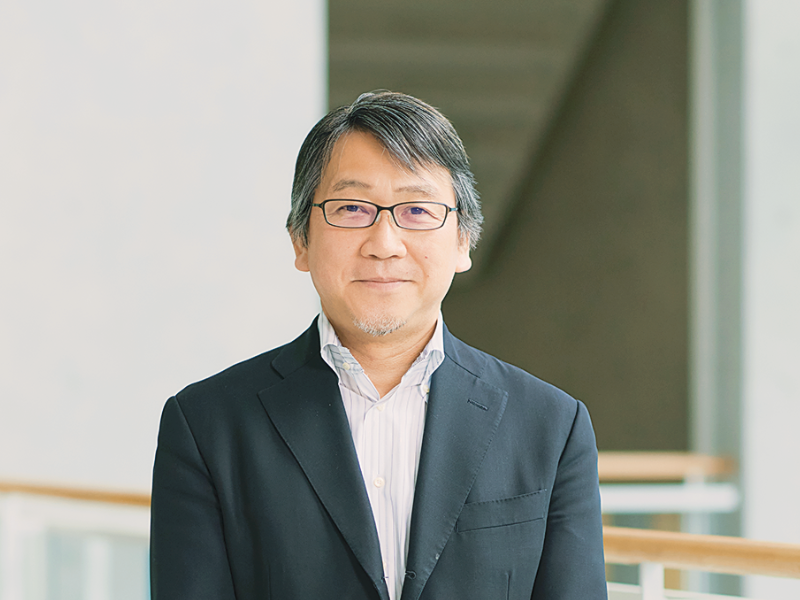
Toru Sato
Professor, Department of Ocean Technology, Policy, and Environment, Graduate School of Frontier Sciences, The University of Tokyo
Director of UT-FloWIND
Floating Systems Open Up a Groundbreaking Future
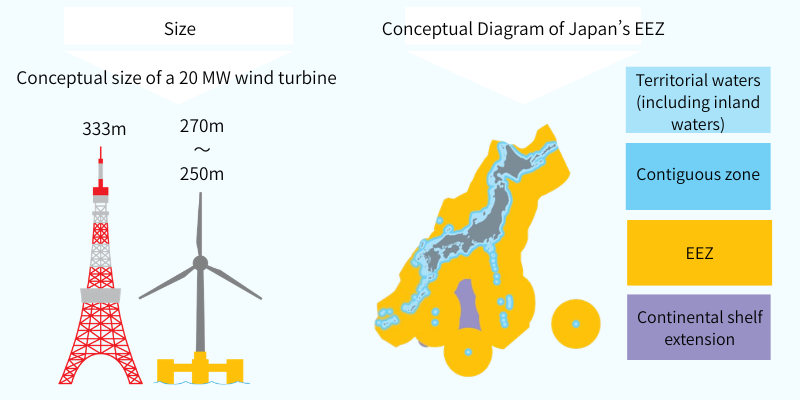
The groundbreaking future that this technology promises is why efforts toward floating offshore wind power are now accelerating nationwide. Achieving the government’s goal would require the deployment of approximately 750 large-scale 20-megawatt wind turbines, comparable in height to Tokyo Tower, within Japan’s EEZ.
Such deployment is expected to generate a massive industry worth several trillion yen across the entire domestic supply chain. In addition, operation and maintenance will create a new industrial base and employment opportunities in rural areas. It could be a powerful driving force for regional development.
Floating offshore wind power also carries another important implication. It enables sensors and monitoring devices to be installed on numerous floating platforms spread across wide ocean areas, allowing them to serve as information and communication hubs that connect the sea surface, subsurface, and deep ocean. A large number of floating systems will serve as platforms for oceanographic information, opening up a new field of “Ocean DX” (as termed by Prof. Sato). This is expected to have an unimaginable impact on academic research.
Characteristics and Objectives of UT-FloWIND
At The University of Tokyo, researchers across multiple departments are conducting world‑class R&D in fields including wind power generation, floating structure engineering, power and grid systems, port, maritime, and ocean engineering, ICT, high‑performance computing (HPC), and ocean and energy policy.
More than 50 of these researchers gathered for the launch of UT-FloWIND. Their collaborative efforts will tackle a broad spectrum of industry challenges, from maximizing power‑generation efficiency on floating structures affected by wave‑and wind‑induced motion, to developing cost‑reducing materials, enhancing maintenance efficiency, deploying monitoring systems on floating platforms to support offshore fisheries, and advancing international collaboration.
Prof. Sato says, “In particular, we aim to realize a Japanese model of floating offshore wind power generation systems that can operate efficiently and stably for a long period in the harsh marine environment of the Asia-Pacific region. In parallel with the research and development of advanced technologies, we will also pursue comprehensive solutions from the perspective of coexistence with local communities such as fisheries, environmental assessment, and ocean and energy policies. Therefore, it is very important to involve researchers from fields such as social sciences, legal systems, international relations, and economics.”
Another major mission of UT-FloWIND is the development of highly specialized human resources. The organization plans to establish a distinctive interdisciplinary education program that integrates coursework and research across departments. Upon completing the required credits, participants will receive certification as specialists in floating offshore wind power.
Organizational Structure of The University of Tokyo Centered on UT-FloWIND

UTokyo International Collaborative Research Organization on Floating Offshore Wind Energy and Related Technologies (UT-FloWIND)
https://fwind.k.u-tokyo.ac.jp/en/
What’s happening now?
October 2020
“Declaration of Carbon Neutrality by 2050”
Japan declared its goal of achieving carbon neutrality by 2050, with renewable energy as the primary power source.
June 2025
Enactment of the Revised “Act on Promoting the Utilization of Sea Areas for the Development of Marine Renewable Energy Power Generation Facilities”
This revision enabled the installation of offshore wind power facilities within Japan’s EEZ.
August 2025
“Offshore Wind Industry Vision (Second Edition)”
A target was set to develop at least 15 GW of floating offshore wind power projects domestically (and 30 GW overseas) by 2040.
*Reported by a working group of the Ministry of Economy, Trade and Industry. One GW (gigawatt) is equivalent to one large nuclear power plant (without accounting for differences in energy conversion efficiency)
Future targets
15 GW of Floating Offshore Wind Power Projects
▲Approximately 750 20-MW wind turbines are required
▲Each turbine is comparable in size to Tokyo Tower
▲Installed within Japan’s EEZ
Key Requirements
●Achieve a domestic procurement ratio of parts 65% or higher by 2040
●Train and secure approximately 40,000 personnel for the offshore wind power sector
*“Offshore Wind Industry Vision (Second Edition)”
●Realize 15 GW of domestic projects by 2040, manufacture approximately 20 units per year by 2030 (at about three assembly sites)
*Estimated by UT-FloWIND
Expected Results
Emergence of a large-scale industry worth several trillion yen across the entire supply chain
Creation of regional industrial infrastructure and employment for operation and maintenance
*“Offshore Wind Industry Vision (Second Edition)”
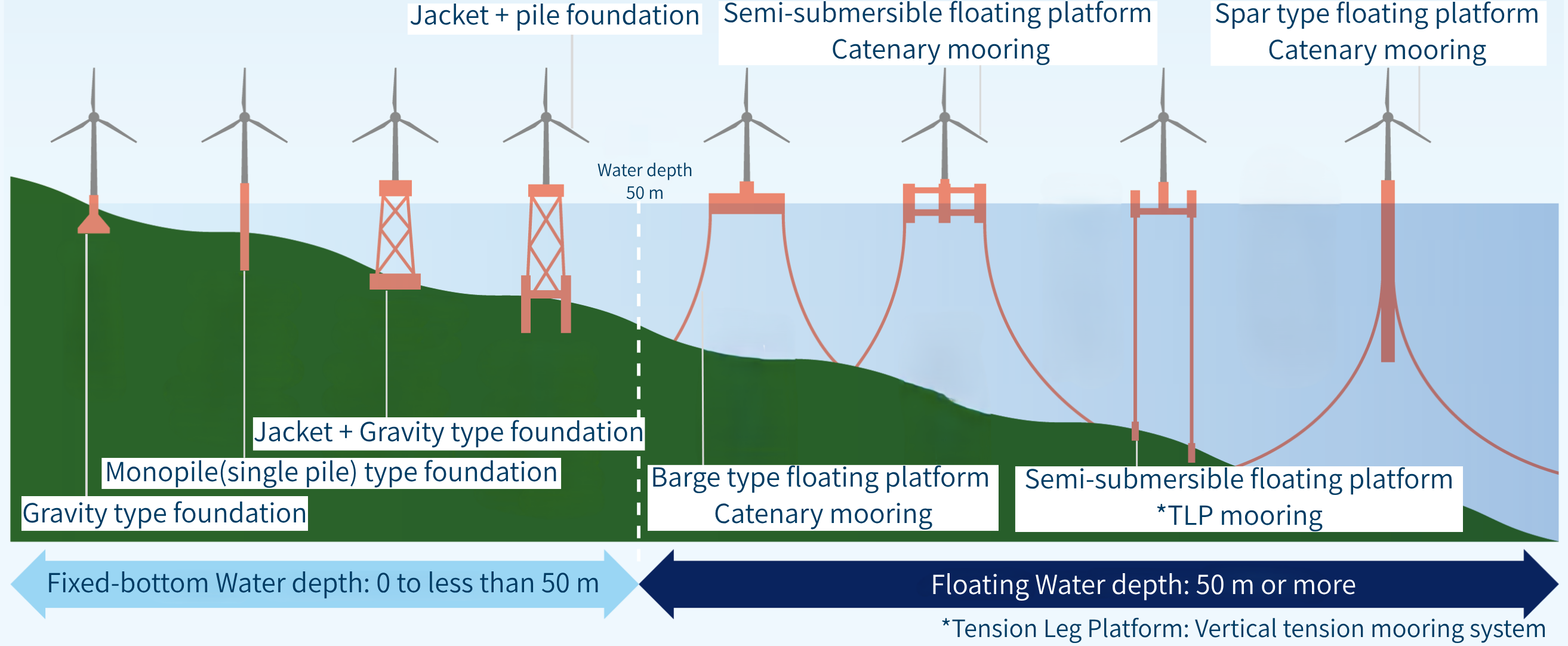
[Column] Differences between Fixed-Bottom and Floating Offshore Wind Power Systems
In fixed-bottom offshore wind systems, turbines are anchored to foundations by extending support structures down to the ocean floor. They are suitable for relatively shallow waters (generally less than 50 m), and have already been put into practical use and are widespread in Europe and other regions. On the other hand, floating offshore wind systems consist of turbines mounted on floating structures, with their position maintained using mooring systems (e.g., anchors and chains). These systems are suitable for deeper waters (generally over 50 m). They represent a new technology worldwide, and demonstration projects have only recently begun. The potential installation area in waters around Japan is estimated to be several times larger than that available for fixed-bottom systems. Because floating systems do not require large support structures, their impact on the marine environment is relatively small. Floating offshore wind systems are also suitable for regions where coastal waters quickly become deep, such as offshore areas of Indonesia, Malaysia, and the South China Sea. As a result, significant expansion into international markets is expected in the future.