
FRONTIER SCIENCES
Ichigaku Takigawa
New Information Science and Machine Learning for Deciphering Life

Our laboratory conducts research in computer science on machine learning and machine discovery methods that contribute to life sciences. Machine learning is the core technology underlying today’s “AI,” and the ability to measure diverse forms of biological data provides a foundation for developing new information science approaches to interpreting that data.
Ichigaku Takigawa
Professor
Division of Biosciences
Department of Computational Biology and Medical Sciences, Data-Driven Intelligence Laboratory
https://takigawa-lab.tokyo/?lang=en
Computer programs are the objects I feel most certain about, embodying mathematical formal systems. If a program does not work as expected, it is because I, the designer, have made a mistake. Through programming, I am constantly reminded of how imprecise and unreliable my own understanding and thinking can be.
In contrast, life, another of my interests, is uncertain and elusive. Although living organisms, as material entities, are continually renewed through metabolism, they appear to maintain a remarkable degree of order, seemingly defying the law of increasing entropy, which states that disorder increases over time. Physicist Schrödinger described this phenomenon as “life feeds on negative entropy.” On the other hand, the mathematician Gelfand said, “There is only one thing more unreasonable than the unreasonable effectiveness of mathematics in physics. It is the unreasonable ineffectiveness of mathematics in biology.” Bioinformatics is often regarded merely as an applied field of information science that analyzes biological data using computational methods. However, for me, it represents a new form of information science that seeks the missing link between two seemingly irreconcilable concepts (computation and life).
My current primary research interests are “machine learning with discrete structures” and “machine discovery in the natural sciences.” A discrete structure is a structure formed by a combination of a finite number of discrete elements. Discrete structures include combinatorial information structures such as sets, logic, sequences, trees, graphs, and networks. Understanding how each element is combined is more important for understanding life than the elements themselves. Life sciences are full of discrete structural data, including genome sequences, molecular structures, and networks of genes and chemical reactions. In conventional machine learning, the focus is generally on multivariate numerical data and their probability distributions. By contrast, data represented as discrete structures, such as genomic sequences, are non-numerical, and it is not immediately obvious what their “average” or “probability distribution” would be, or even how such concepts should be defined. Applying statistical methods to discrete structures of this kind requires addressing a range of technical challenges in information science, making it a fascinating area of research at the intersection of discrete mathematics, algorithms, probability, and statistics.
Another area of interest, “machine discovery in the natural sciences,” refers to the effective use of machine learning for achieving genuine scientific discovery. Machine learning predictions are essentially interpolations based on large amounts of data and are computed as averages over those data. Such averages are, by definition, the most mundane ones and are far from what scientists seek, namely, insights into what is not yet known or does not exist. Machine discovery is a new topic that goes beyond simply applying existing machine learning techniques, aiming instead to bridge the technical gap required to seek “what is not in the data” based on “what is in the data.”
While AI technologies have become increasingly familiar through practical applications such as image, speech, and language processing, there remains a strong need to further advance the underlying information science of machine learning itself if it is to make a truly meaningful contribution to scientific research.

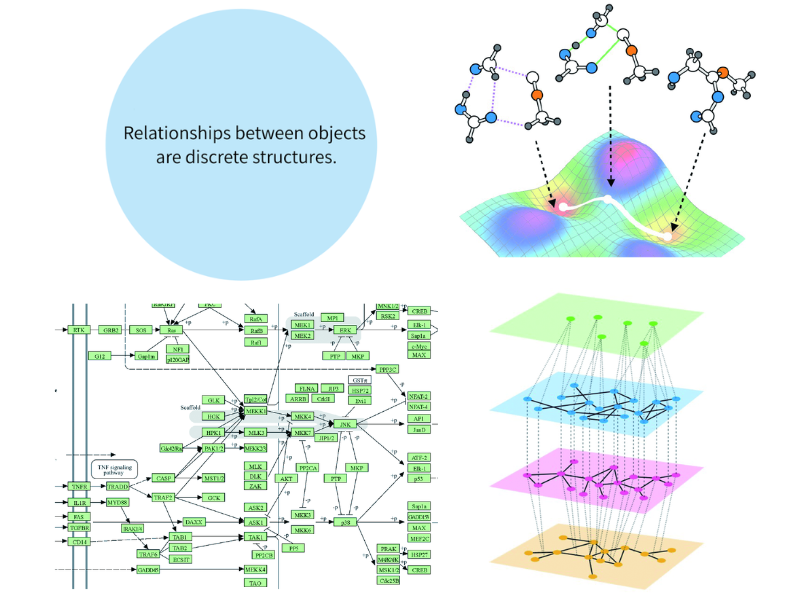
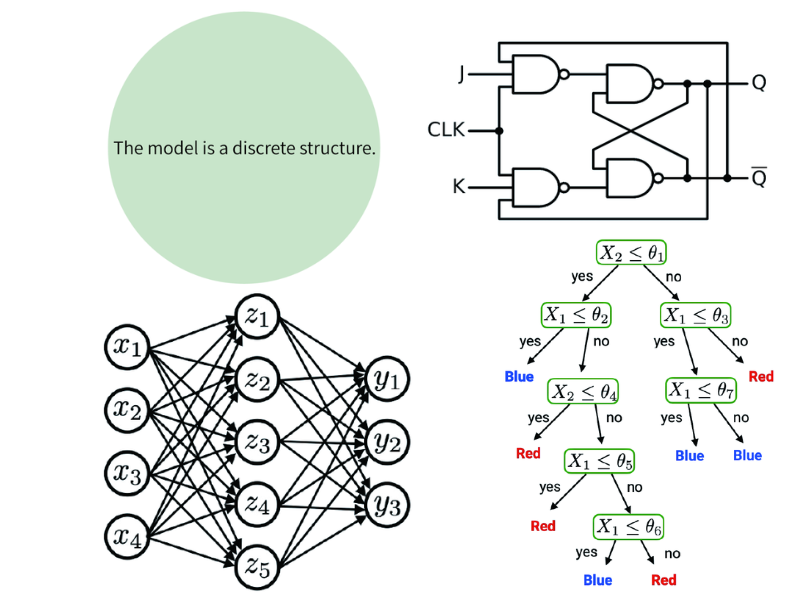
Machine Learning with Discrete Structures
Discrete structure = information resulting from a combination of a finite number of discrete elements. Sets, logic, series, trees, graphs, programs, languages, etc.

A research paper on the development of a highly robust underwater adhesive using machine learning was featured on the cover of the journal Nature.

vol.47
- cover
- Floating Offshore Wind Power: Paving the Way for the Future
- Toward the Practical Application of Floating Offshore Wind Power
- Examples of Research on Floating Offshore Wind Power in the Graduate School of Frontier Sciences
- Exploring the Interaction between Plasma and Materials: From Nuclear Fusion to the Creation of Functional Materials
- New Information Science and Machine Learning for Deciphering Life