
FRONTIER SCIENCES
Shin Kajita
Exploring the Interaction between Plasma and Materials: From Nuclear Fusion to the Creation of Functional Materials

The fundamental scientific study of interactions between plasma and materials has the potential not only to enable fusion energy, but also to drive the development of new functional materials. It is expected that the integration of energy, materials, and AI will be a key factor in advancing next-generation science and technology.
Shin Kajita
Professor
Division of Transdisciplinary Sciences
Department of Advanced Energy Engineering, Laboratory of Plasma Science and Engineering
https://www.ppl.k.u-tokyo.ac.jp/
Our research primarily focuses on the interaction between reactor walls and plasma in fusion reactors and also includes studies on the diagnosis of relatively low-temperature plasmas (approximately ≤100,000 K) and material applications. The research is organized around three main pillars: (1) the measurement and control of plasma near the fusion reactor wall, (2) plasma–material interactions in fusion reactors, and (3) the creation of functional materials through the use of plasma–material interactions.
At the core of a fusion reactor, temperatures can reach approximately 100 million degrees, forming plasma (consisting of positively charged nuclei and negatively charged electrons). The plasma is confined in a magnetic field cage; however, there are regions where it interacts with the reactor wall. Without appropriate control, the heat load in such regions can exceed engineering limits (approximately 10 MW/m2, comparable to the heat load experienced by spacecraft during atmospheric re-entry), leading to material failure. To address this, various gases are introduced to reduce the plasma temperature to around 10,000 K, enabling plasma extinction through a process known as “recombination.” This approach, known as “detached plasma,” involves complex atomic and molecular processes, making it challenging to model the emitted radiation. Fig. 1 (showing argon and helium plasmas) illustrates that emission characteristics such as color and brightness vary depending on gas species, temperature, and density, indicating that emitted light contains critical diagnostic information. Over the past decade, efforts have been made to utilize plasma emission in combination with machine learning for plasma diagnostics and control, and this approach has proven highly effective. It is expected that AI-based measurement and control will become even more sophisticated in the future.
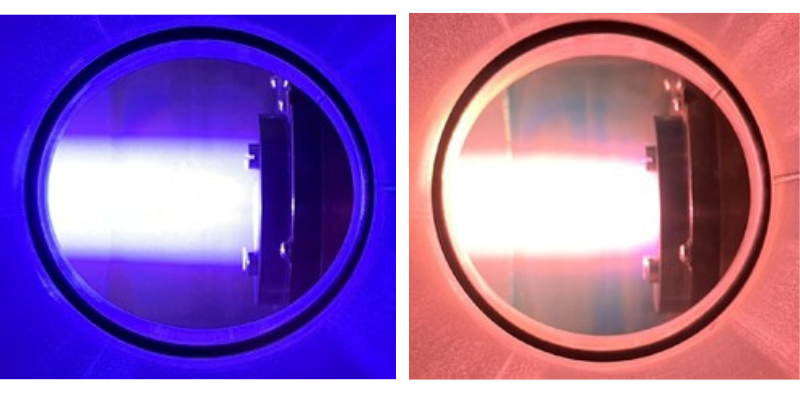
Fig. 1 Argon plasma (left) and helium plasma (right).
No matter how much control is applied, high-energy ions (hydrogen isotopes and helium) inevitably enter the wall material. There is a region called the “divertor” where the plasma is particularly concentrated, and the most promising candidate material at present is tungsten, which has also been used in light bulb filaments. Hydrogen and helium atoms are very small and can penetrate into tungsten, leading to structural changes such as blistering and the formation of bubbly nanostructures. Under certain conditions, helium in particular can cause these nanobubbles to evolve into a “nanofuzz” structure (Fig. 2), significantly altering the material properties. For example, an extremely large drop in thermal conductivity, down to just 0.2%, has been observed. Research is being conducted on irradiation under the complex conditions present in actual fusion reactors, including the deposition of tungsten from reactor materials and the presence of trace amounts of other mixed gases.
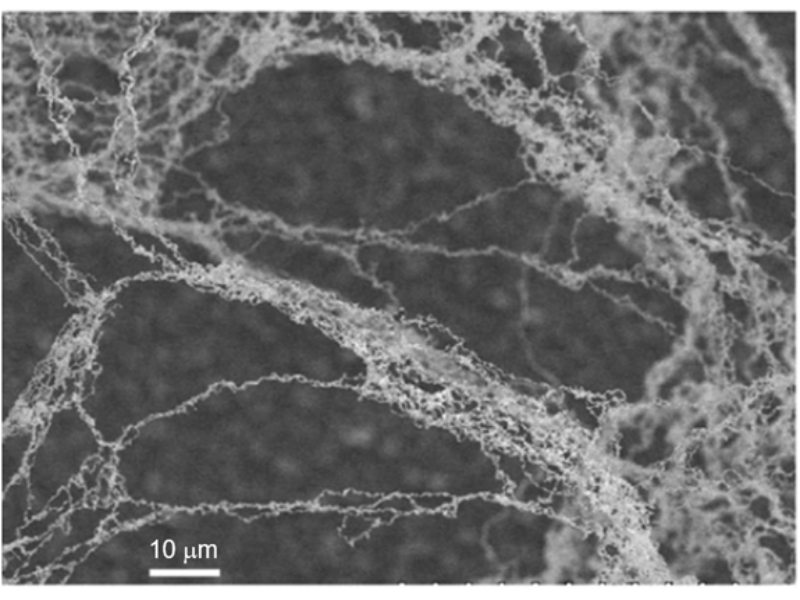
Fig. 2 Electron micrograph of fibrous nanofuzz tungsten formed through interaction with helium plasma.
As described above, plasma exposure leads to the formation of nanoporous structures, such as nanobubbles and nanofuzz (structures with numerous nanoscale pores). From the perspective of fusion reactors, these effects are generally negative. However, from a different perspective, such structures can be utilized as new materials with advanced functionalities. Nanoporosity occurs not only in tungsten, but also in various metals and semiconductor materials, resulting in a substantial increase in surface area and highly efficient light absorption. Metals can be oxidized to semiconductors, enabling potential applications such as gas sensors, photoelectrochemical electrodes for hydrogen and oxygen generation from water using solar energy, and highly efficient light-diffusing materials. Materials such as porous silicon are also attracting attention as electrode materials for lithium-ion batteries. Our current research aims to utilize plasma not only for nanostructuring but also for mixing and bonding different materials, thereby enabling the creation of advanced functional materials.
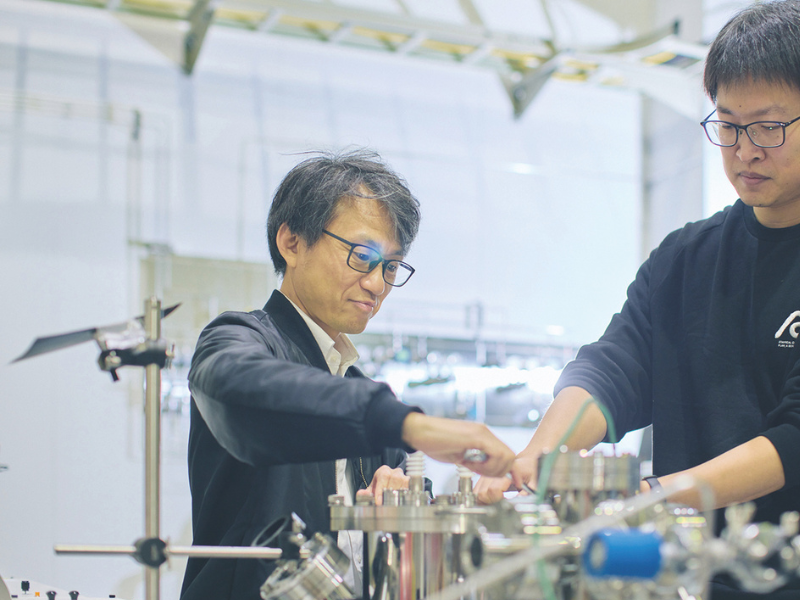
Assistant Professor Shi Quan working with a laser-based thin film deposition system.
vol.47
- cover
- Floating Offshore Wind Power: Paving the Way for the Future
- Toward the Practical Application of Floating Offshore Wind Power
- Examples of Research on Floating Offshore Wind Power in the Graduate School of Frontier Sciences
- Exploring the Interaction between Plasma and Materials: From Nuclear Fusion to the Creation of Functional Materials