
Why Do Next-Generation High-Temperature Alloys Fail by Oxidation? University of Tokyo Researchers Reveal Key Mechanisms in Niobium-Based Alloys
- Headline
- Press Release
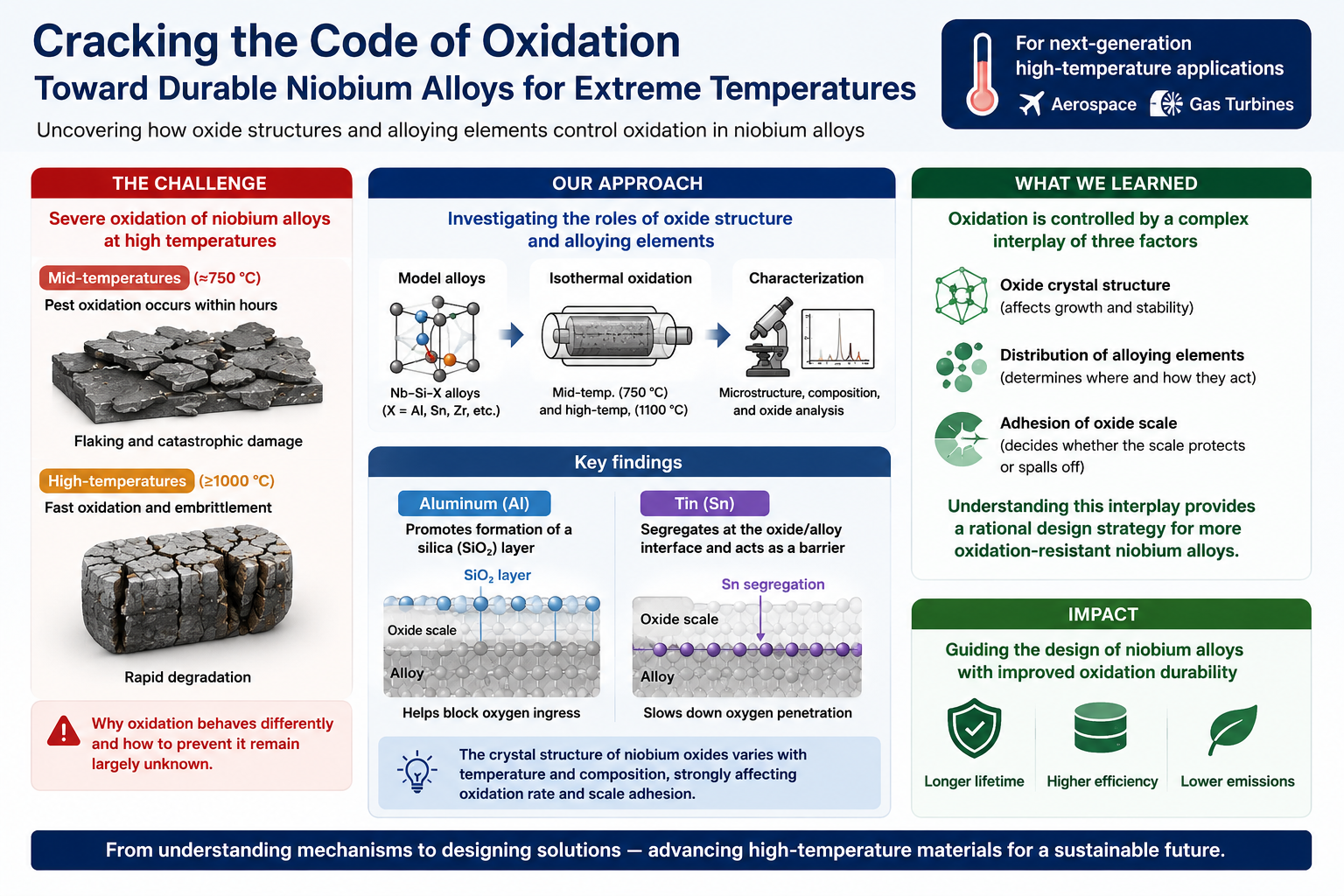
Schematic overview of the study (created using GPT-5.5 on May 13, 2026)
The University of Tokyo researchers have clarified how niobium-based alloys degrade during high-temperature oxidation, providing new insight into the design of oxidation-resistant materials for future aerospace engines and power-generation turbines.
Niobium-based alloys are promising candidates for next-generation high-temperature structural materials because they can retain strength at temperatures beyond the limits of many conventional alloys. However, their poor oxidation resistance remains a major obstacle to practical use. When exposed to high-temperature air, niobium reacts readily with oxygen, forming oxide scales that can crack, spall, and, under some conditions, cause the material to fragment catastrophically.
Assistant Professor Sae Matsunaga at the Graduate School of Frontier Sciences (GSFS), Aya Ajina (undergraduate student at the Department of Materials Engineering at that time), and Professor Yoko Yamabe-Mitarai at GSFS, investigated the oxidation behavior of model niobium-based alloys at 750 °C and 1100 °C. The team used niobium silicide-based alloys as benchmark materials because they can form both potentially protective oxides and oxides that accelerate degradation, making them suitable for studying the mechanisms of oxidation damage.
The researchers examined oxidation kinetics, oxide-scale morphology, oxide crystal structures, and the distribution of alloying elements. They found that the crystal structure of niobium oxide changed depending on both temperature and alloy composition, and that these changes were closely related to oxidation rate, cracking, and scale spallation.
“Our results show that oxidation degradation in niobium-based alloys is not controlled simply by whether oxides form, but by what kind of oxides form, how they evolve, and how alloying elements redistribute during oxidation,” Matsunaga explained.
The study also revealed distinct roles of aluminum and tin. Aluminum promoted the formation of a protective silica layer, which helped suppress oxygen ingress. Tin segregated near the interface between the oxide scale and the underlying alloy, forming a barrier that hindered further transport of oxygen and metallic elements. Together, these effects improved oxidation resistance and oxide-scale adhesion.
These findings provide mechanistic guidance for designing niobium-based alloys with improved oxidation resistance. Such materials could contribute to the development of future high-temperature components for aircraft engines, gas turbines, and other extreme-environment technologies.
The team’s findings have been published in the peer-reviewed journal, Corrosion Science. Their research has received funding from the The Amada Foundation.
Papers
Journal: Corrosion ScienceTitle: The roles of Nb2O5 phase evolution and solute interactions in temperature-dependent oxidation degradation mechanisms of Nb-based alloysAuthors: Sae Matsunaga1*, Aya Ajina2, Yoko Yamabe-Mitarai11Graduate School of Frontier Sciences, The University of Tokyo, 2Department of Materials Engineering, The University of TokyoDOI: 10.1016/j.corsci.2026.113898URL: https://doi.org/10.1016/j.corsci.2026.113898

