
What makes the Japanese gut microbiome unique? Insights from a global comparison
- Headline
- Press Release
Key Findings
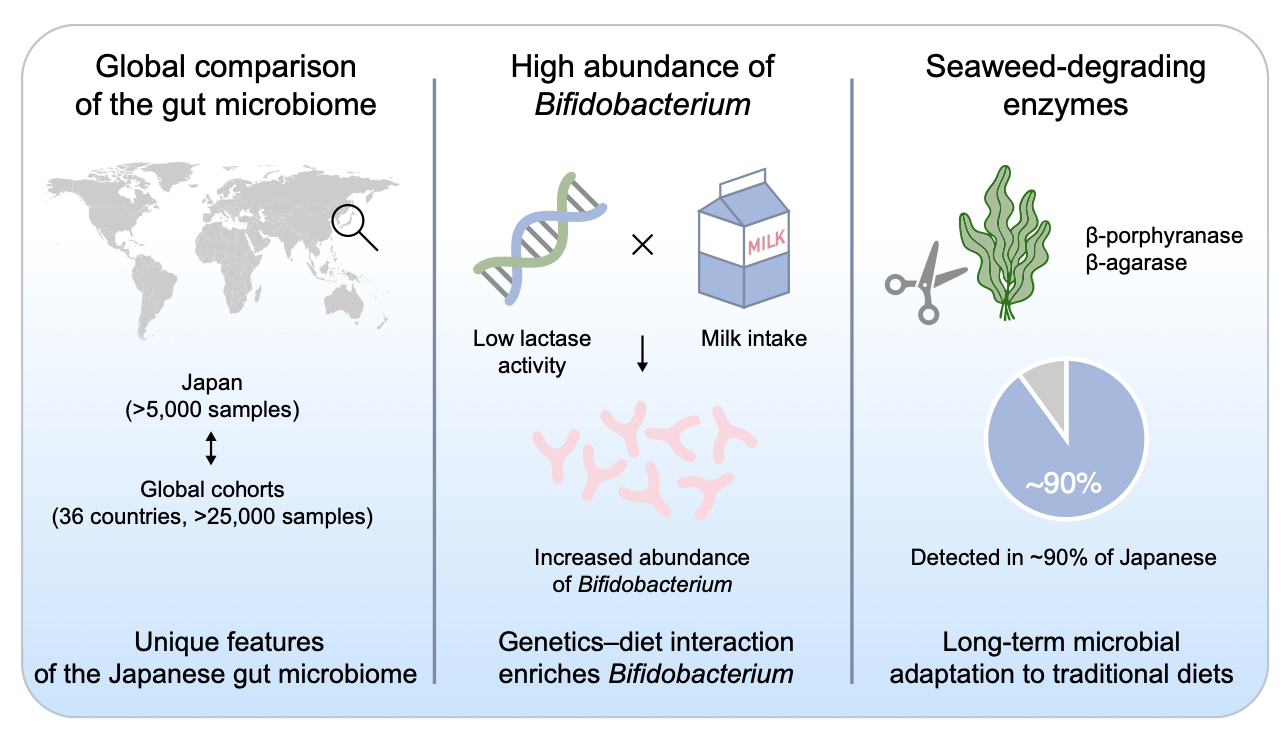
• A large-scale global comparison of gut microbiome data from over 5,000 Japanese individuals and 25,000 individuals across 36 countries revealed distinctive features of the Japanese gut microbiome.
• The high abundance of Bifidobacterium in Japanese individuals appears to result from the interaction between lactose intolerance–associated genetics and increased dairy consumption, while seaweed-degrading enzyme genes were detected in most Japanese individuals but remain rare elsewhere.
• By placing Japanese microbiome features within a global context, this study provides a foundation for future microbiome-based preventive and personalized medicine.
Overview
The human gut harbors hundreds of trillions of microorganisms that together form a complex ecosystem known as the gut microbiome1, which plays essential roles in digestion, metabolism, immune regulation, and overall human health. Recent studies have shown that the gut microbiome is strongly shaped by factors such as age, diet, lifestyle, genetic background, and geography. However, the specific characteristics of the Japanese gut microbiome, shaped by genetic backgrounds and dietary traditions distinct from those of Western populations, have so far been discussed mainly on the basis of relatively small-scale datasets.
To address this gap, a research team led by Suguru Nishijima (The University of Tokyo), Masahira Hattori (Waseda University), and Naoyoshi Nagata (Tokyo Medical University) conducted a large-scale comparative analysis of gut metagenomes2 from more than 5,000 Japanese individuals. These data, including 4,198 participants from the Japanese 4D microbiome cohort3, were integrated with global datasets comprising over 25,000 individuals from 36 countries, enabling a comprehensive assessment of the Japanese gut microbiome in a global context.

Figure 1 | Distinct features of the Japanese gut microbiome in a global context
(A) Principal component analysis (PCA) of gut microbiomes from 31,695 samples across 37 countries. Each dot represents the country-level mean, and error bars indicate standard deviations. Dot color denotes geographic region, and dot size reflects the number of samples from each country.
(B) Genus-level taxonomic composition of the gut microbiome across countries. Bar plots show the mean relative abundance of each genus, with sample sizes indicated in parentheses. The 30 most abundant genera are shown.
(C) Gut bacterial genera that are significantly enriched or depleted in Japanese individuals.
Global context of the Japanese gut microbiome
Principal component analysis of gut microbiome profiles from 37 countries showed that the Japanese gut microbiome clusters with populations from high-income countries (Figure 1A). This cluster is characterized by an enrichment of Bacteroides and depletion of Prevotella (Figure 1B). Beyond these broad similarities, comparisons across countries identified numerous genera that are significantly enriched or depleted in Japanese individuals, revealing a distinct microbial signature that differentiates the Japanese gut microbiome from those of other populations (Figure 1C).
A combination of genetics and diet shapes the enrichment of Bifidobacterium
One of the most notable features identified in this study is the high abundance of Bifidobacterium in the Japanese gut microbiome (Figure 1C). Comparative analyses that incorporated dietary information and genetic background across countries revealed that this enrichment is closely associated with an interaction between milk consumption and a genetic trait common in non-Western populations, namely, the absence of lactase activity in adulthood (Figure 2).
In many Japanese individuals, lactose contained in milk is not fully digested in the small intestine and instead reaches the colon, where it serves as an important energy source for Bifidobacterium, promoting its growth. In contrast, many individuals in Western populations retain lactase activity into adulthood, resulting in efficient lactose digestion and little stimulation of Bifidobacterium following milk intake.
Importantly, milk consumption in Japan increased rapidly after World War II, driven by school lunch programs and broader dietary shifts. The findings suggest that this relatively recent dietary change, when combined with a genetic background characterized by reduced lactose digestion, has played a key role in shaping the modern Japanese gut microbiome.
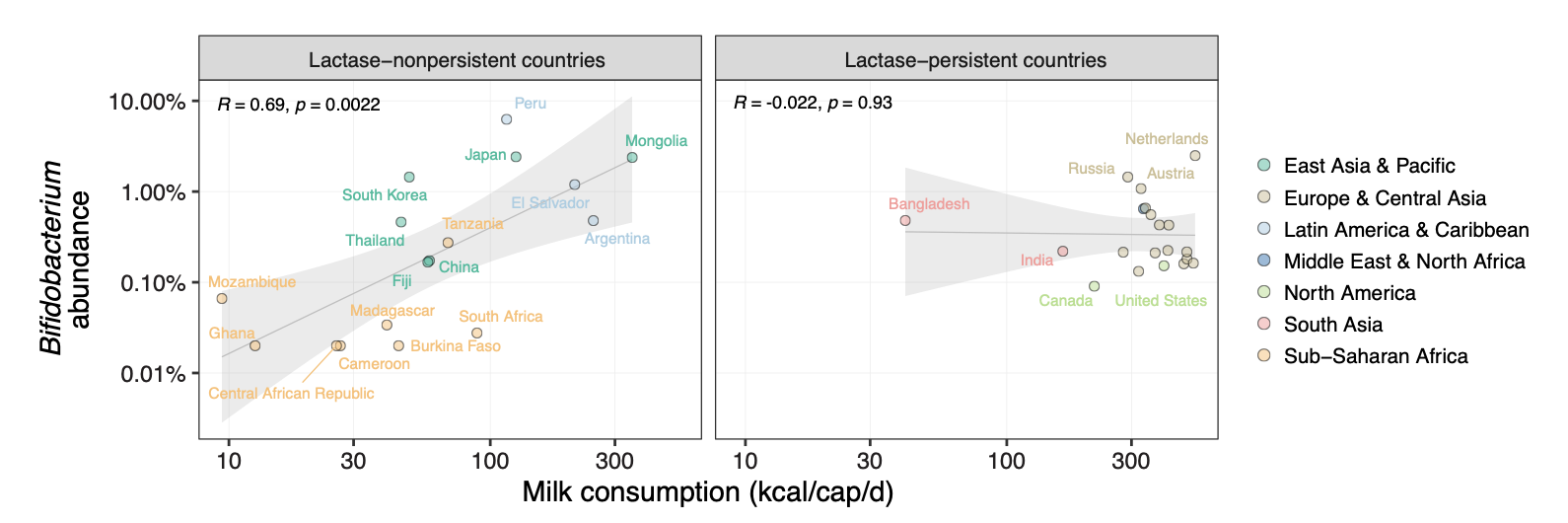
Figure 2 | Association between Bifidobacterium abundance, milk consumption, and lactose digestion–related genetic background
Relationship between the mean abundance of Bifidobacterium and per capita milk consumption across countries. Countries are grouped according to lactose tolerance status.
Long-term microbial adaptation to traditional diets
Another distinctive feature linked to traditional Japanese dietary culture was the widespread presence of genes encoding enzymes that degrade polysaccharides found in edible seaweeds such as nori and wakame. These genes were detected in more than 90% of Japanese gut microbiomes (Figure 3).
Polysaccharides derived from seaweeds differ substantially in chemical structure from those found in terrestrial plants such as vegetables and grains, and their degradation requires specialized enzymes that humans do not possess. The enzymes identified in this study were frequently observed in East Asian populations, where seaweed has long been consumed as a staple food, but were rarely detected in populations from Europe, the Americas, or Africa. This finding represents a clear example of how gut microbes adapt to long-standing dietary practices and co-evolve with their human hosts.
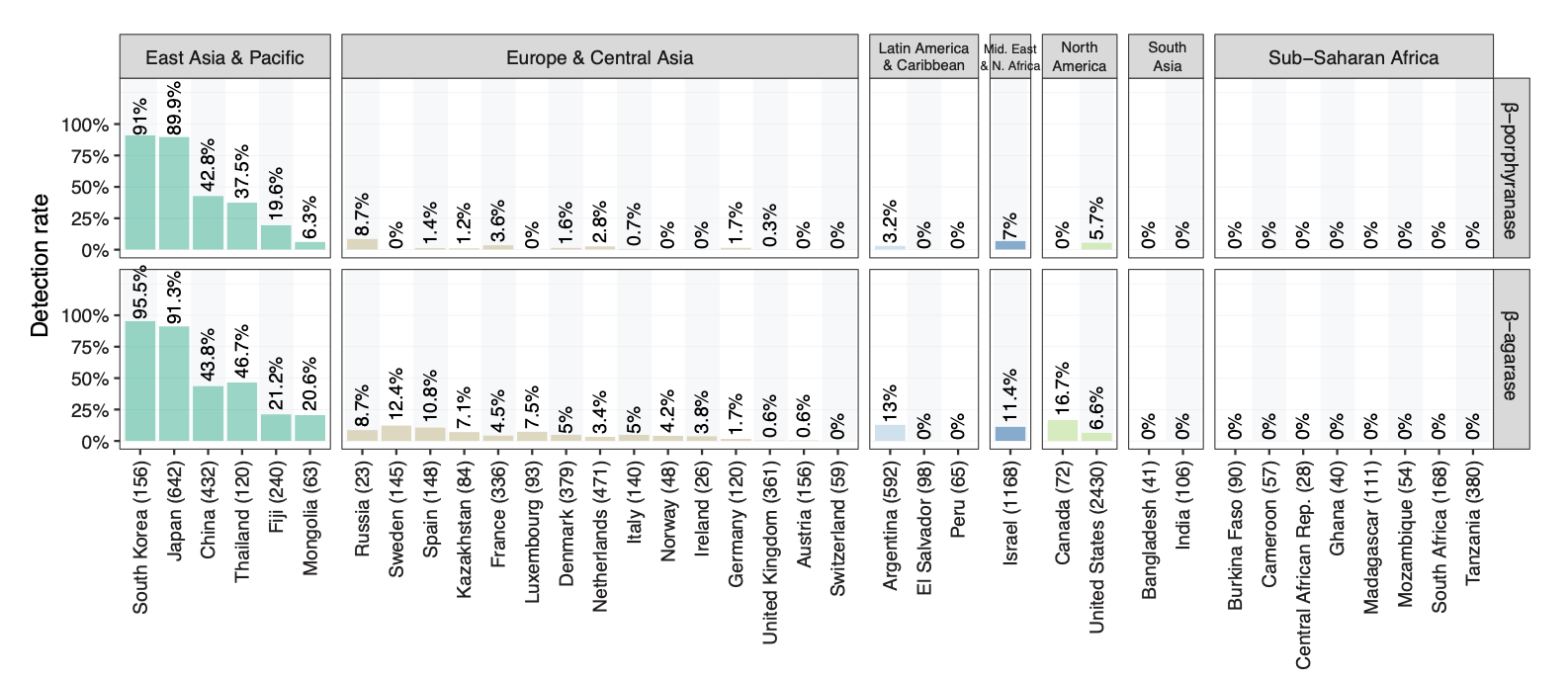
Figure 3 | Global distribution of genes encoding enzymes that degrade seaweed-derived polysaccharides
Detection rates of genes encoding enzymes that degrade polysaccharides found in edible seaweeds, such as nori and wakame (β-porphyranase and β-agarase). Numbers in parentheses indicate the sample sizes used for analysis.
Associations with age, sex, and BMI
In addition, the study examined associations between the Japanese gut microbiome and basic individual characteristics, including age, sex, and body mass index (BMI). The analysis revealed that certain bacterial taxa increase with age, while others are more prevalent in younger individuals. Sex-specific differences were also observed, with Prevotella being more abundant in men and Eggerthella being more abundant in women. Body composition was also associated with gut microbial profiles, as individuals with higher BMI tended to harbor increased abundances of several genera, such as Acidaminococcus and Megasphaera. Together, these results demonstrate that the Japanese gut microbiome is closely linked to fundamental individual differences in age, sex, and body composition.
Significance
This study organizes the distinctive features of the Japanese gut microbiome through the lens of interactions between genetic background and dietary culture, and places them within a global framework using large-scale metagenomic data. High-resolution analyses of large Japanese cohorts provide an essential foundation for future advances in preventive medicine and microbiome-informed personalized healthcare.
Information on the authors and research team
Life Data Science Center, Graduate School of Frontier Sciences, the University of Tokyo
Dr. Suguru Nishijima
Faculty of Science and Engineering, Waseda University
Dr. Masahira Hattori
Center for Health Surveillance and Preventive Medicine, Tokyo Medical University
Dr. Naoyoshi Nagata
Publication Information
Journal: Proceedings of the Japan Academy, Ser. B
Title: The Japanese gut microbiome: ecology, uniqueness, and impact on health and disease
Authors: Suguru Nishijima†, Masahira Hattori†, and Naoyoshi Nagata† (†Corresponding author)
DOI: 10.2183/pjab.102.006
URL: https://doi.org/10.2183/pjab.102.006
Glossary
Note 1: Gut microbiome
A term referring to the collective community of microorganisms living in the human gut, including bacteria and other microbes, as well as their genes. The gut microbiome plays critical roles in human health, including digestion, immune regulation, and metabolism.
Note 2: Metagenomic data
Data obtained by extracting and sequencing all microbial DNA directly from a sample, without culturing individual microorganisms. Analysis of metagenomic data enables comprehensive characterization of which microorganisms are present in the gut, their relative abundances, and the genes they carry.
Note 3: Japanese 4D microbiome cohort
A large-scale, integrative omics research platform established in Japan that collects and integrates detailed information on Disease, Drug use, Diet, and Daily life, together with microbiome data. The Japanese 4D microbiome cohort integrates gut and salivary microbiome data with multiple layers of omics data, such as metabolites, blood cytokine and chemokine profiles, and host genomic information, to elucidate disease associations and develop novel biomarkers.

