
CONDENSED MATTER QUANTUM PHASE PHYSICS
TAKASADA SHIBAUCHI & Kousuke Ishida LAB.
INTRODUCTION OF LABORATORY
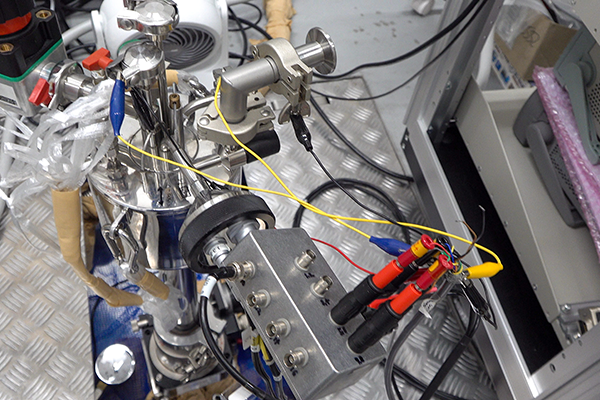
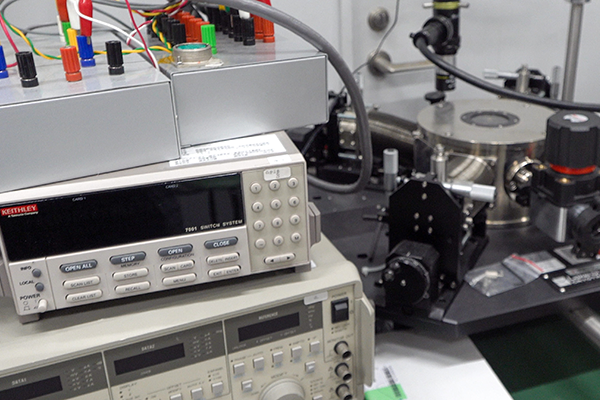
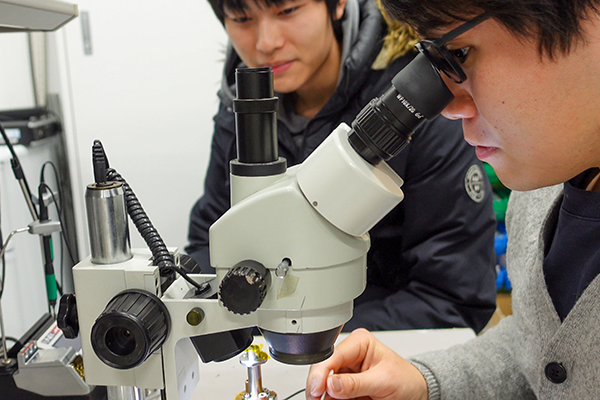
Our research interests focus on the “Quantum Phases of Matter” such as high-transition-temperature superconductivity, in which anomalous physical properties appear owing to the quantum effects of interacting electrons in materials. Engineering of charge, spin, and orbital degrees of freedom of electrons in such quantum phases of matter may lead to the developments of next-generation functional materials. The current research projects include: (1) Understanding of the origin of high-temperature-transition superconductivity, (2) Physics of quantum criticality and BCS-BEC crossover and its relation to high-temperature superconductivity, (3) Quantum liquid crystals and quantum glasses, and (4) Experimental verification of new states of matter that are predicted by theories, such as quantum spin liquids in frustrated magnets and topological superconductivity with gapless edge states. We design our own low-temperature measurement apparatuses, make original programs to control them, and develop new analyses by ourselves. These experiences will enhance your experimental skills, which may be helpful for your research career.
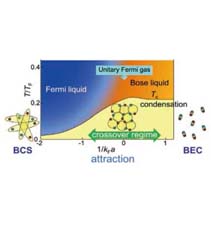
BCS-BECクロスオーバーの概念図
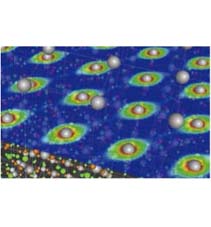
放電子液晶状態の概念図
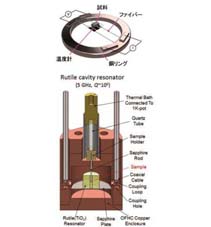
長時間緩和法による精密比熱測定(上図)とルチル空洞共振器によるマイクロ波測定(下図)
MESSAGE
TEST YOUR ORIGINAL IDEA BY YOUR OWN EXPERIMENTS. REGARDLESS OF THE RESULTS, YOU CAN ENJOY SCIENCE.
The beauty of the BSC theory of superconductivity, which made significant and highly influential contributions to various other fields of physics as well, continues to fascinate many researchers. As the Nobel laure-ate P. W. Anderson phrased “More is differ-ent”, the interactions between many elec-trons in materials lead to a plethora of non-trivial phenomena. High-temperature superconductivity is one of these anomalous phases, which cannot be understood by the current standard theories of condensed matter physics. In the field of materials science, we study many aspects of condensed matter. Therefore, even for students just started research, there are several opportunities for testing their own original ideas by designing and perform-ing experiments by themselves. No matter how small your idea is, and no matter wheth-er the results are positive or negative, you will find that it is actually the best part of science. Enjoy your research life in our department.
keyword
Quantum critical point / Iron-based superconductivity / Magnetic field penetration depth / Symmetry breaking / Superconducting gap / Effective mass / Antiferromagnetism / Pseudo gap / Time reversal symmetry / Unconventional superconductivity / Magnetic torque / Heavy electron system / Strongly correlated electron systems / epitaxial growth / anisotropic superconductivity / upper critical magnetic field / rotational symmetry / superconductivity /Nematic order / high-temperature superconductivity / high-temperature superconductor / electron nematic / gap structure / specific heat / low-temperature physical property measurement / angular dependence / second-order phase transition / electron nematic phase / hidden order / Fermi surface / cyclotron resonance / spatial inversion symmetry nature / quantum critical phenomenon / stacked structure / superlattice / non-Fermi liquid / electronic correlation / f-electron system / quantum fluctuation / microwave absorption / plasma resonance / organic superconductor / micro sample / micro single crystal / capacitance measurement / membrane / Faraday force / magnetic field gradient / dilution refrigerator temperature / magnetization measurement / circularly polarized microwave / nematic superconductivity / time reversal symmetry breaking /
Bogoliubov Fermi surface / Bogoliubov Fermi surface / Ultranodal / Quantum liquid / Soft matter / Quantum many-body effect / Electronic liquid crystal / Nematic / Self-assembly / Spin liquid crystal / Tunnel spectroscopy / Thermodynamic measurement / Muon spin relaxation / Elasticity Resistance / Nematicity / Multiband / Bogoliubov quasiparticle / Bose condensation / Electronic structure / Tunnel magnetoresistive element / Chiral antiferromagnetism / Surface magnetic field distribution / Topological materials / Scanning magnetic microscope / Hall element / Scanning microscope / Edge current / Chiral Magnetism / Weyl magnetism / Orbital magnetization / Berry phase / Electron nematic order / Superconducting fluctuations / Strongly coupled superconductivity / Fermi energy / BCS-BEC crossover / Quantum phase transition / Chemical substitution / Electron phase diagram / Anomalous metals / Pressure effect / Uranium compounds / Domain structure / Chiral antiferromagnets / Scanning probe microscope / Strongly correlated superconductivity / Domain / Chirality / Critical current density / Critical State /
Superconductor / Local field distribution / Current distribution / Critical current / Magnetic field distribution / Critical current density / Local magnetic field distribution / Magneto-optic effect / Critical current density / Critical state / Superconductor / Local magnetic field / Quantum fluctuation / Lower critical magnetic field / Vortex thread Physics / Critical magnetic field / Quasiparticle excitation / Superconducting properties / Molecular beam epitaxy / Rashba splitting / Spin-orbit interaction / Pauli effect / Nematic susceptibility / Crystal structure analysis / Structural analysis / Nematic phase / Composition dependence / Orthorhombic crystal / Iron-based superconductor / magnetic anisotropy / orthorhombic distortion / strongly correlated system / rotational symmetry breaking / scattering time / superconducting gap structure / nematic state / FFLO state / superlattice structure / two-dimensionality / thin film / Rare earth compounds /π junction / Superconducting symmetry / Dimensional control / Josephson junction / Pi junction / High magnetic field properties / Interlayer conduction / Intrinsic tunneling properties / Copper oxide high temperature superconductor / Tunnel resistance / Negative magnetoresistance / Micro mesa structure / Impurity phase / Intrinsic Josephson junction / Electron-hole symmetry / Overdoping / Interlayer tunneling resistance / Josephson effect / Magnetic flux correlation / Vortex state / Decoupling transition / Layered superconductor / Decoupling / First-order phase transition / Genus shaped superconductor / Josephson coupling / Josephson plasma / cavity resonator / surface impedance
PROFILE : Professor Takasada Shibauchi
1990 B.Eng., Department of Applied Physics, University of Tokyo
1993 Research Associate, Department of Applied Physics, University of Tokyo
1999 Ph.D. (Eng.), University of Tokyo
1999 Postdoctoral Fellow, Los Alamos National Laboratory
1999 Visiting Scientist, IBM T. J. Watson Research Center
2001 J. Robert Oppenheimer Fellow, Los Alamos National Laboratory
2001 Associate Professor, Dept. Electronic Sci. & Eng., Kyoto University
2005 Associate Professor, Department of Physics, Kyoto University
2014 Professor, Department of Advanced Materials Science, University of Tokyo
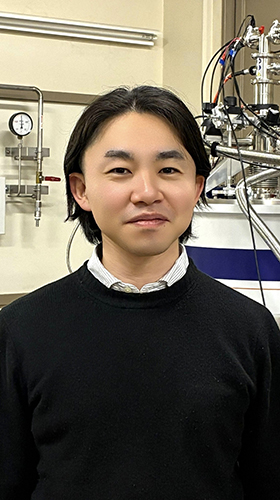
Lecturer Kousuke Ishida
PROFILE
2016 B.Eng., Department of Applied Physics, The University of Tokyo
2021 Ph.D. (Science), Department of Advanced Materials Science, Graduate School of Frontier Sciences, The University of Tokyo
2021 JSPS Overseas Research Fellow (Max Planck Institute for Chemical Physics of Solids)
2023 Assistant Professor, Institute for Materials Research, Tohoku University
2026 Lecturer, Department of Advanced Materials Science, Graduate School of Frontier Sciences, The University of Tokyo
keyword
Strongly correlated electron systems / Quantum critical point / Quantum fluctuations / Singularities / Non-Fermi liquid / Strange metal / Unconventional superconductivity / Superconducting gap structure / Pseudogap / Electronic nematic order / Electronic nematic susceptibility / Rotational symmetry breaking / Charge order / Hidden order / Chirality / Broken inversion symmetry / Nonreciprocal phenomena / Electric polarization / Flexoelectric effect / Quantum paraelectricity / Dielectric permittivity / Uniaxial stress / Uniaxial strain / Stress–strain curve / Elastoresistance / Young’s modulus / Superelasticity / Elastocaloric effect / First-order phase transition / Upper critical field / Strain gradient / Iron-based superconductors / Cuprate high-temperature superconductors / Ruthenate superconductors / Ultra-low-temperature precision measurements / High magnetic field experiments / Electrical resistivity / Magnetoresistance / Capacitance measurement / Pyroelectric current measurement / Synchrotron X-ray diffraction / Microfabrication / Piezoelectric devices / Single-crystal growth
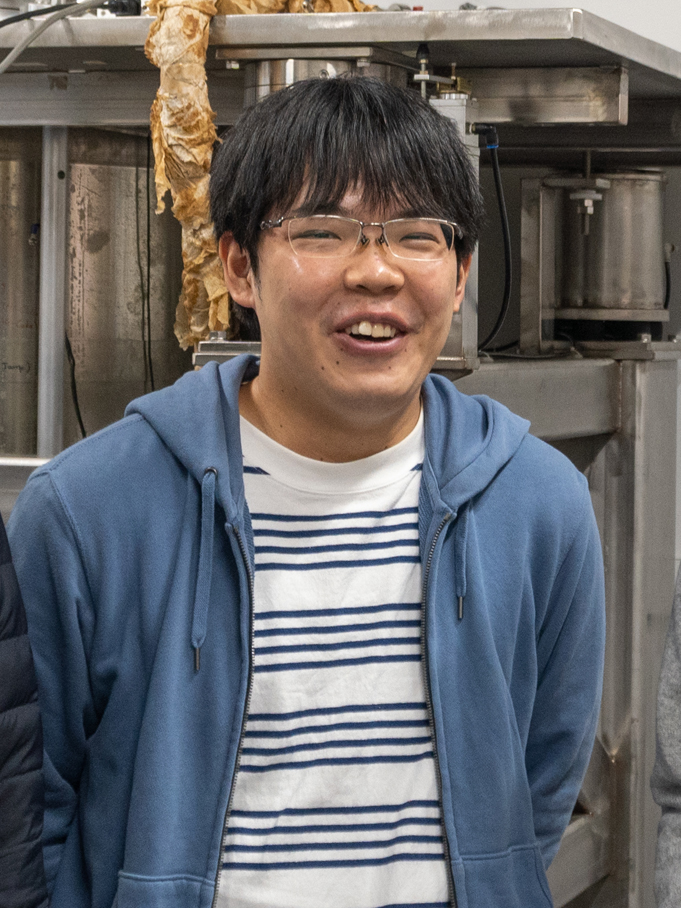
STUDENT VOICE : KOTA ISHIHARA
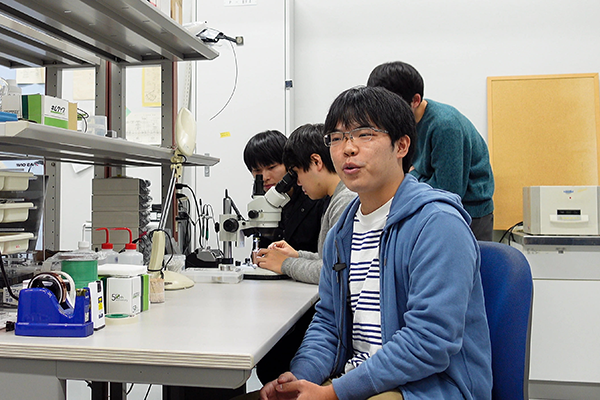
Profs. Shibauchi and Hashimoto are world-leading researchers in the field of strongly correlated electron systems. Because they always give us proper advices based on their extensive knowledge and experience, we can progress our research step by step. They also respect our opinions and ideas about our research, so we can freely enjoy our research. Our research interests consist of various topics, such as the mechanism of high-transition-temperature superconductivity and recently proposed novel quantum states. Because all topics are very interesting and related to fundamental understandings of the condensed matter physics, I really enjoy to gradually progress my research through trials and errors.
APPLIED PHYSICS
We are conducting research to elucidate various non-trivial states exhibited by multiple electrons in materials.
Takasada Shibauchi & Kenichiro Hashimoto Lab.,
Department Of Advanced Materials Science,
Graduate School of Frontier Sciences,
The University of Tokyo
Kashiwanoha 5-1-5,
Kashiwa,Chiba 277-8561, Japan
+81-4-7136-3774(Shibauchi)
shibauchi@k.u-tokyo.ac.jp
+81-4-7136-4048(Ishida)
k.ishida@edu.k.u-tokyo.ac.jp
The Goal of Applied Physics
The goal of Applied Physics is to develop a stage = “new material” that can manipulate undeveloped degrees of freedom, to explore unknown phenomena created from that stage and to bring out excellent functions, and to bring out its excellent functions. The purpose is to contribute to the development of human society by elucidating the mechanisms and developing application fields for these phenomena and functions.
AMS (Advanced Materials Science)
Department Office
AMS (Advanced Materials Science),
Graduate School of Frontier Sciences,
The University of Tokyo
Kashiwanoha 5-1-5, Kashiwa, Chiba 277-8561, Japan
Email : ams-office(at)ams.k.u-tokyo.ac.jp
Please change (at) to @.