
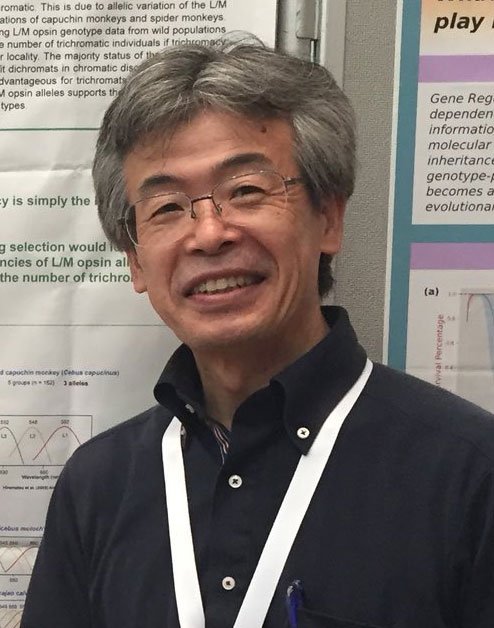
河村 正二
(かわむら しょうじ/教授/生命科学研究系)
先端生命科学専攻/人類進化システム分野講座/感覚系遺伝子の進化生態遺伝学 ~ヒト、野生霊長類、魚類の視覚とケミカルセンスに注目して~
略歴
1986年 3月 東京大学 理学部 生物学科 人類学課程 卒業
1991年 3月 東京大学 大学院理学系研究科 人類学専攻 博士課程 修了(理学博士)
1991年 4月 日本学術振興会特別研究員(PD)
1992年 1月 米国シラキュース大学 生物学専攻 Shozo Yokoyama研究室 ポストドクトラル研究員
1996年 9月 東京大学 大学院理学系研究科 生物科学専攻 助手
1999年 4月 東京大学 大学院新領域創成科学研究科 生命科学研究系 先端生命科学専攻 助教授(2007年4月より准教授に改称)
2010年10月 東京大学 大学院新領域創成科学研究科 生命科学研究系 先端生命科学専攻 教授(~現在)
2017年4月~2019年3月 先端生命科学専攻長
2022年4月~2023年3月 先端生命科学専攻長
2023年4月~2025年3月 生命科学研究系長
教育活動
大学院:適応進化遺伝学、生命科学英語特論、生命科学英語演習
教養学部:総合科目E(物質・生命)・人類科学・人間の本質にせまる科学
研究活動
ヒトを含む霊長類を中心に、感覚センサーの遺伝子実体が知られている色覚(opsin)、嗅覚(olfactory receptor: OR)、旨味・甘味(TAS1R)、苦味(TAS2R)の多様性と適応進化の解明に取り組んでいます。
文献
* Corresponding author
<原著論文>(査読有)<Original articles in peer-reviewed journals> (Current or past Lab members boldfaced)
- Hou, M., Akhtar, M. S., Hayashi, M., Ashino, R., Matsumoto-Oda, A., Hayakawa, T., Ishida, T, Melin, A. D., Imai, H. and *Kawamura, S. (2024 Apr 11). Reduction of bitter taste receptor gene family in folivorous colobine primates relative to omnivorous cercopithecine primates. Primates 65: Online.
- Sakamoto, S., Matsushita, Y., Itoigawa, A., Ezawa, T., Fujitani, T., Takakura, K., Zhou, Y., Zhang, G., Grutzner, F., *Kawamura, S. and *Hayakawa, T. (2024 Jan 2). Color vision evolution in egg‑laying mammals: insights from visual photoreceptors and daily activities of Australian echidnas. Zoological Letters 10: 2.
- Suire, A., Kunita, I. Harel, R., Crofoot, M., Mutinda, M., Kamau, M., Hassel, J. M., Murray, S., Kawamura, S., *Matsumoto-Oda, A. (2023 Nov 8). Estimating individual exposure to predation risk in group-living baboons, Papio Anubis. PLoS ONE 18(11): e0287357.
- *Hiramatsu, C., Takashima, T., Sakaguchi, H., Chen, X., Tajima, S., Seno, T. and Kawamura, S. (2023 Sep 13). Influence of colour vision on attention to, and impression of, complex aesthetic images. Proceedings of the Royal Society B, 290 (2006): 20231332.
- *#Melin, A. D., *#Veilleux, C. C., Janiak, M. C., Hiramatsu, C., Sánchez-Solano, K. G., Lundeen, I. K., Webb, S. E., Williamson, R. E., Mah, M. A., Murillo-Chacon, E., Schaffner, C. M., Hernández-Salazar, L., Aureli, F. and *Kawamura, S. (2022 Aug 31). Anatomy and dietary specialization influence sensory behaviour among sympatric primates. Proceedings of the Royal Society B, 289 (1981): 20220847. #Equally contributed.
- *Munds, R. A., Cooper, E., Janiak, M. C., Lam, L. G., DeCasien, A., Surratt, S. B., Montague, M., Martinez, M., Cayo-Biobank-Research-Unit, Kawamura, S., *Higham, J. P. and *Melin, A. D. (2022 Aug). Variation and heritability of retinal cone ratios in a free-ranging population of rhesus macaques. Evolution, 76 (8): 1776-1789.
- Akhtar, M. S., Ashino, R., Oota, H., Ishida, H., Niimura, Y., Touhara, K., Melin, A. D. and *Kawamura, S. (2022 Jul 22). Genetic variation of olfactory receptor gene family in a Japanese population. Anthropological Science, 130 (2): 93-106.
- *Wikberg, E. C., Jack, K. M., Campos, F. A., Bergstrom, M. L., Kawamura, S. and Fedigan, L. M. (2022 July). Should I stay or should I go now: Dispersal decisions and reproductive success in male white-faced capuchins (Cebus imitator). Behavioral Ecology and Sociobiology, 76 (7): 88.
- #Toda, Y., #Hayakawa, T., Itoigawa, A., Kurihara, Y., Nakagita, T., Hayashi, M., Ashino, R., Melin, A. D., Ishimaru, Y., *Kawamura, S., *Imai, H., and *Misaka, T. (2021 Oct 25). Evolution of the primate glutamate taste sensor from a nucleotide sensor. Current Biology 31 (20): 4641-4649.e5. #Equally contributed. Correction (2021 Oct 25). Current Biology 31 (20): 4675-4676. プレスリリース2021年8月27日
- *Veilleux, C. C., Kawamura, S., Montague, M. J., Hiwatashi, T., Matsushita, Y., Fernandez-Duque, E., Link, A., Di Fiore, A., D. and *Max Snodderly, M. (2021 May) Color vision and niche partitioning in a diverse neotropical primate community in lowland Amazonian Ecuador. Ecology and Evolution, 11 (10): 5742-5758.
- *Orkin, J. D., Montague, M. J., Tejada-Martinez, D., de Manuel, M., del Campo, J., Hernandez, S. C., Di Fiore, A., Fontsere, C., Hodgson, J. A., Janiak, M. C., Kuderna, L. F. K., Lizano, E., Martin, M. P., Niimura, Y., Perry, G. H., Valverde, C. S., Tang, J., Warren, W. C., de Magalhaes, J. P., Kawamura, S., Marques-Bonet, T., Krawetz, R. and *Melin, A. D. (2021 Feb 16). The genomics of ecological flexibility, large brains, and long lives in capuchin monkeys revealed with fecalFACS. Proceedings of the National Academy of Sciences of the United States of America, 118 (7): e2010632118.
- Hao, Q., Zheng, M., Weng, K., Hao, Y., Zhou, Y., Lin, Y., Gao, F., Kou, Z., Kawamura, S., Yao, K., Xu, P., Chen, J., *Zou, J. (2021 Jan 20). Crumbs proteins stabilize the cone mosaics of photoreceptors and improve vision in zebrafish. Journal of Genetics and Genomics, 48 (1): 52-62.
- *Nishikawa, M., Ferrer, N., Cheves, S., Lopez, R., Kawamura, S., Fedigan, L. M., Melin, A. D., Jack, K. M. (2020 Dec). Infant cannibalism in wild white-faced capuchin monkeys. Ecology and Evolution, 10 (23): 12679-12684.
- *Matsumoto, Y., Oda, S., Mitani, H. and *Kawamura, S. (2020 June). Orthologous divergence and paralogous anticonvergence in molecular evolution of triplicated green opsin genes in medaka fish, genus Oryzias. Genome Biology and Evolution, 12 (6): 911–923.
- Mackin, R. D., Frey, R. A., Gutierrez, C., Farre, A. A., Kawamura, S., Mitchell, D. M. and *Stenkamp, D. L. (2019 Aug 20). Endocrine regulation of multichromatic color vision. Proceedings of the National Academy of Sciences of the United States of America, 116 (34): 16882-16891.
- *Melin, A. D., Nevo, O., Shirasu, M., Williamson, R. E., Garrett, E., M., Sakurai, K., Matsushita, Y., Touhara, K. and *Kawamura, S. (2019 Jun 3). Fruit scent and observer colour vision shape food-selection strategies in wild capuchin monkeys. Nature Communications, 10:2407.
- Kuroki-Kami, A., Nichuguti, N., Yatabe, H., Mizuno, S., Kawamura, S. and *Fujiwara, H. (2019 May 22). Targeted gene knockin in zebrafish using the 28S rDNA-specific non-LTR retrotransposon R2Ol. Mobile DNA, 10: 23.
- *Wikberg, E. C., Jack, K. M., Fedigan, L. M. and Kawamura, S. (2018 Dec). The effects of dispersal and reproductive patterns on the evolution of male sociality in white-faced capuchins. In Primate Life History, Sex Roles, and Adaptability - Essays in Honour of Linda M. Fedigan (Kalbitzer, U. and Jack, K. M. eds.), pp. 117-132, Springer Nature Switzerland AG, Cham, Switzerland.
- Sakai, Y., Kawamura, S. and *Kawata, M. (2018 Nov 27). Genetic and plastic variation in opsin gene expression, light sensitivity and female response to visual signals in the guppy. Proceedings of the National Academy of Sciences of the United States of America, 115 (48): 12247-12252.
- Hogan, J. D., Fedigan, L. M., Hiramatsu, C., Kawamura, S. and *Melin, A. D. (2018 Jul 18). Trichromatic perception of flower colour improves resource detection among New World monkeys. Scientific Reports, 8: 10883.
- *Brasington, L. F., Wikberg, E. C., Kawamura, S., Fedigan, L. M. and Jack, K. M. (2017 Dec). Infant mortality in white-faced capuchins: the impact of alpha male replacements. American Journal of Primatology, 79 (12): e22725.
- *Melin, A. D., Chiou, K. L., Walco, E. R., Bergstrom, M., L., Kawamura, S. and Fedigan, L. M. (2017 Sep 26). Trichromacy increases fruit intake rates of wild capuchins (Cebus capucinus imitator). Proceedings of the National Academy of Sciences of the United States of America, 114 (39): 10402–10407.
- Jinam, T. A., Phipps, M. E., Aghakhanian, F., Majumder, P. P., Datar, F., Stoneking, M., Sawai, H., Nishida, N., Tokunaga, K., Kawamura, S., Omoto, K. and *Saitou, N. (2017 Aug). Discerning the origins of the Negritos, first Sundaland people: deep divergence and archaic admixture. Genome Biology and Evolution, 9 (8):2013–2022.
- Koganebuchi, K., Haneji, K., Toma, T., Joh, K., Soejima, H., Fujimoto, K., Ishida, H., Ogawa, M., Hanihara, T., Harada, S., Kawamura, S. and *Oota, H. (2017 Mar). The allele frequency of ALDH2*Glu504Lys and ADH1B*Arg47His for the Ryukyu islanders and their history of expansion among East Asians. American Journal of Human Biology, 29 (2): e22933.
- *Melin, A. D., Khetpal, V., Matsushita, Y., Zhou, K., Campos, F. A., Welker, B. and Kawamura, S. (2017 Mar). Howler monkey foraging ecology suggests convergent evolution of routine trichromacy as an adaptation for folivory. Ecology and Evolution 7 (5): 1421-1434. Journal Cover Image
- *Kalbitzer, U., Bergstrom, M. L., Carnegie, S. D., Wikberg, E. C., Kawamura, S., Campos, F. A., Jack, K. M. and Fedigan, L. M. (2017 Feb 21). Female sociality and sexual conflict shape offspring survival in a Neotropical primate. Proceedings of the National Academy of Sciences of the United States of America, 114 (8): 1892-1897. New Scientist 6 Feb 2017, PHYS ORG 7 Feb 2017
- *Wikberg, E. C., Jack, K. M., Fedigan, L. M., Campos, F. A., Yashima, A. S., Bergstrom, M. L., Hiwatashi, T., Kawamura, S. (2017 Jan). Inbreeding avoidance and female mate choice shape reproductive skew in capuchin monkeys (Cebus capucinus imitator). Molecular Ecology, 26 (2): 653-667. Journal Cover Image
- Tsutsui, K., Otoh, M., Sakurai, K., Suzuki-Hashido, N., Hayakawa, T., Misaka, T., Ishimaru, Y., Aurel, F., Melin, A. D., *Kawamura, S. and *Imai, H. (2016 Oct 12). Variation in ligand responses of the bitter taste receptors TAS2R1 and TAS2R4 among New World monkeys. BMC Evolutionary Biology, 16: 208. Video
- *Kawamura, S., Kasagi, S., Kasai, D., Tezuka, A., Shoji, A., Takahashi, A., Imai, H. and Kawata, M. (2016 Oct). Spectral sensitivity of guppy visual pigments reconstituted in vitro to resolve association of opsins with cone cell types. Vision Research, 127: 67–73.
- Katsumura, T.†, Fukuyo, Y.†, Kawamura, S. and *Oota, H. (2016 Sep 28). A comparative study on the regulatory region of the PERIOD1 gene among diurnal/nocturnal primates. Journal of Physiological Anthropology, 35: 21. †Equally contributed.
- *Sargeant, E. J., Wikberg, E. C., Kawamura, S., Jack, K. M. and Fedigan, L. M. (2016 June). Paternal kin recognition and infant care in white-faced capuchins (Cebus capucinus). American Journal of Primatology, 78 (6): 659–668.
- Sakai, Y., Ohtsuki, H., Kasagi, S., Kawamura, S. and *Kawata, M. (2016 May 18). Effects of light environment during growth on the expression of cone opsin genes and behavioral spectral sensitivities in guppies (Poecilia reticulata). BMC Evolutionary Biology, 16: 106.
- *Melin, A. D., Wells, K., Moritz, G. L., Kistler, L., Orkin, J. D., Timm, R. M., Bernard, H., Lakim, M. B., Perry, G. H., Kawamura, S. and *Dominy, N. J. (2016 Apr). Euarchontan opsin variation brings new focus to primate origins. Molecular Biology and Evolution, 33 (4): 1029-1041.
- *Tsujimura, T., Masuda, R., Ashino, R. and *Kawamura, S. (2015 Nov 4). Spatially differentiated expression of quadruplicated green-sensitive RH2 opsin genes in zebrafish is determined by proximal regulatory regions and gene order to the locus control region. BMC Genetics, 16: 130.
- *Sargeant, E. J., Wikberg, E. C., Kawamura, S. and Fedigan, L. M. (2015 Oct). Allonursing in white-faced capuchins (Cebus capucinus) provides evidence for cooperative care of infants. Behaviour, 152 (12-13): 1841-1869.
- Mitchell, D. M., Stevens, C. B., Frey, R. A., Hunter, S. S., Ashino, R., Kawamura, S. and *Stenkamp, D. L. (2015 Aug). Retinoic acid signaling regulates differential expression of the tandemly-duplicated long wavelength-sensitive cone opsin genes in zebrafish. PLoS Genetics, 11 (8): e1005483.
- Nakagome, S., Sato, T., Ishida, H., Hanihara, T., Yamaguchi, T., Kimura, R., *Mano, S., *Oota, H., Omoto, K., Tokunaga, K., Saitou, N., Kawamura, S., Tanabe, H., Umetsu, K., Tajima, A., Osada, N., Yamamoto, T., Ohashi, J., Suto, Y., Nishida, N., Sakate, R. and Sawai, H. (2015 Jun). Model-based verification of hypotheses on the origin of modern Japanese revisited by Bayesian inference based on genome-wide SNP data. Molecular Biology and Evolution, 32 (6): 1533-1543.
- *Kasagi, S., Mizusawa, K., Murakami, N., Andoh, T., Furufuji, S., Kawamura, S. and Takahashi, A. (2015 Feb 10). Molecular and functional characterization of opsins in barfin flounder (Verasper moseri). Gene, 556 (2): 182-191.
- Katsumura, T., Oda, S., Nakagome, S., Hanihara, T., Kataoka, H., Mitani, H., Kawamura, S. and *Oota, H. (2014 Dec 22). Natural allelic variations of xenobiotic metabolizing enzymes pleiotropically affect sexual dimorphism in Oryzias latipes. Proceedings of the Royal Society B, 281 (1797): 20142259.
- *Schoof, V. A. M., Wikberg, E. C., Jack, K. M., Fedigan, L. M., Ziegler, T. E. and Kawamura, S. (2014 Dec). Infanticides during periods of social stability: kinship, resumption of ovarian cycling, and mating access in white-faced capuchins (Cebus capucinus). Neotropical Primates, 21 (2): 192-196.
- Tezuka, A., Kasagi, S., van Oosterhout, C., McMullan, M., Iwasaki, W. M., Kasai, D., Yamamichi, M., Innan, H., *Kawamura, S. and *Kawata, M. (2014 Nov). Divergent selection for opsin gene variation in guppy (Poecilia reticulata) populations of Trinidad and Tobago. Heredity, 113 (5): 381-389.
- *Wikberg, E. V., Jack, K. M., Campos, F. A., Fedigan, L. M., Sato, A., Bergstrom, M. L., Hiwatashi, T. and Kawamura, S. (2014 Oct). The effect of male parallel dispersal on the kin composition of groups in white-faced capuchins. Animal Behaviour, 96: 9-17.
- *Takezawa, Y., Kato, K., H., Caulfield, T., Fujimoto, A., Honda, F., Kamatani, N., Kawamura, S., Kawashima, K., Kimura, R., Matsumae, H., Saito, A., Savage, P. E., Seguchi, N., Shimizu, K., Terao, S., Yamaguchi-Kabata, Y., Yasukouchi, A., Yoneda, M. and Tokunaga, K. (2014 Apr 23). Correspondence: Human genetic research, race, ethnicity and the labeling of populations: recommendations based on an interdisciplinary workshop in Japan. BMC Medical Ethics, 15: 33.
- Matsumoto, Y., Hiramatsu, C., Matsushita, Y., Ozawa, N., Ashino, R., Nakata, M., Kasagi, S., Di Fiore, A. Schaffner, C. M., Aureli, F., Melin, A. D. and *Kawamura, S. (2014 Apr). Evolutionary renovation of L/M opsin polymorphism confers a fruit discrimination advantage to ateline New World monkeys. Molecular Ecology, 23 (7): 1799-1812.
- Matsushita, Y., Oota, H., Welker, B. J., Pavelka, M. S. and *Kawamura, S. (2014 Feb). Color vision variation as evidenced by hybrid L/M opsin genes in wild populations of trichromatic Alouatta New World monkeys. International Journal of Primatology, 35 (1): 71-87.
- *Melin, A. D., Hiramatsu, C., Parr, N. A., Matsushita, Y., Kawamura, S. and Fedigan, L. M. (2014 Feb). The behavioral ecology of color vision: considering fruit conspicuity, detection distance and dietary importance. International Journal of Primatology, 35 (1): 258-287.
- *Fedigan, L. M., Melin, A. D., Addicott, J. F. and Kawamura, S. (2014 Jan 3). The heterozygote superiority hypothesis for polymorphic color vision is not supported by long-term fitness data from wild Neotropical monkeys. PLoS One, 9 (1): e84872.
- Suzuki, S. C., Bleckert, A., Williams, P. R., Takechi, M., Kawamura, S. and *Wong, R. O. L. (2013 Sep 10). Cone photoreceptor types in zebrafish are generated by symmetric terminal divisions of dedicated precursors. Proceedings of the National Academy of Sciences of the United States of America, 110 (37): 15109-15114.
- *Aureli, F., Di Fiore, A., Murillo-Chacon, E., Kawamura, S. and Schaffner, C. M. (2013 Sep). Male philopatry in spider monkeys revisited. American Journal of Physical Anthropology, 152 (1): 86-95.
- Fang, W., Bonaffini, S., Zou, J., Wang, X., Zhang, C., Tsujimura, T., Kawamura, S. and *Wei, X. (2013 Jun-Jul). Characterization of transgenic zebrafish lines that express GFP in the retina, pineal gland, olfactory bulb, hatching gland, and optic tectum. Gene Expression Patterns, 13 (5-6): 150-159.
- *#Melin, A. D., #Matsushita, Y., Moritz, G. L., Dominy, N. J. and *Kawamura, S. (2013 May 22). Inferred L/M cone opsin polymorphism of ancestral tarsiers sheds dim light on the origin of anthropoid primates. Proceedings of the Royal Society B, 280 (1759): 20130189. #Equally contributed. Journal Cover Image. The New York Times, 1 April 2013.
- Japanese Archipelago Human Population Genetics Consortium: Jinam, T., Nishida, N., Hirai, M., Kawamura, S., Oota, H., Umetsu, K., Kimura, R., Ohashi, J., Tajima, A., Yamamoto, T., Tanabe, H., Mano, S., Suto, Y., Kaname, T., Naritomi, K., Yanagi, K., Niikawa, N., *Omoto, K., *Tokunaga, K. and *Saitou, N. (2012 Dec). The history of human populations in the Japanese Archipelago inferred from genomewide SNP data with a special reference to the Ainu and the Ryukyuan populations. Journal of Human Genetics, 57 (12): 787-795.
- Koganebuchi, K., Katsumura, T., Nakagome, S., Ishida, H., Kawamura, S., *Oota, H. and The Asian Archival DNA Repository Consortium (2012 Dec). Autosomal and Y-chromosomal STR markers reveal a close relationship between Hokkaido Ainu and Ryukyu islanders. Anthropological Science, 120 (3): 199-208.
- *Li, Y. N., Tsujimura, T., Kawamura, S. and Dowling, J. E. (2012 Nov 1). Bipolar cell–photoreceptor connectivity in the zebrafish (Danio rerio) retina. The Journal of Comparative Neurology, 520 (16): 3786–3802.
- Nakagome, S., Mano, S., Kozlowski, L., Bujnicki, J. M., Shibata, H., Fukumaki, Y., Kidd, J. R., Kidd, K. K., Kawamura, S. and *Oota, H. (2012 Jun). Crohn’s disease risk alleles on the NOD2 locus have been maintained by natural selection on standing variation. Molecular Biology and Evolution, 29 (6): 1569-1585.
- Katsumura, T., Oda, S., Tsukamoto, K., Sekiya, Y., Yamashita, T., Aso, M., Hata, M., Nonaka, M., Mano, S., Ishida, H., Mitani, H., Kawamura, S. and *Oota, H. (2012 Apr). A population genetic study on the relationship between medaka fish and the spread of wet-rice cultivation across the Japanese archipelago. Anthropological Science, 120 (1): 81-89.
- Wu, P. C., Chen, J.-B., Kawamura, S., Roos, C., Merker, S., Shih, C.-C., Hsu, B.-D., Lim, C. and *Chang, T. W. (2012 Apr). The IgE gene in primates exhibits extraordinary evolutionary diversity. Immunogenetics, 64 (4): 279-287.
- *Melin, A. D., Moritz, G. L., Fosbury, R. A. E., Kawamura, S. and *Dominy, N. J. (2012 Mar). Commentary: Why aye-ayes see blue. American Journal of Primatology, 74 (3):185-192.
- Hiwatashi, T., Mikami, A., Katsumura, T., Suryobroto, B., Perwitasari-Farajallah, D., Malaivijitnond, S., Siriaroonrat, B., Oota, H., Goto, S. and *Kawamura, S. (2011 Oct 22). Gene conversion and purifying selection shape nucleotide variation in gibbon L/M opsin genes. BMC Evolutionary Biology, 11: 312.
- *Miyazaki, T., Nakata, M., Kasagi, S., Iwami, T., Yamauchi, M. and Kawamura, S. (2011 Feb). Molecular cloning of ultraviolet-sensitive visual pigment in juvenile Champsocephalus gunnari (Channichthyidae). Polar Biology, 34 (2): 235-242.
- Tsujimura, T., Hosoya, T. and *Kawamura, S. (2010 Dec). A single enhancer regulating the differential expression of duplicated red-sensitive opsin genes in zebrafish. PLoS Genetics, 6 (12): e1001245.
- *Allison, W. T., Barthel, L. K., Skebo, K. M., Takechi, M., Kawamura, S. and Raymond, P. A. (2010 Oct 15). Ontogeny of cone photoreceptor mosaics in zebrafish. The Journal of Comparative Neurology, 518 (20): 4182-4195.
- Matsukusa, H., *Oota, H., Haneji, K., Toma, T., Kawamura, S. and Ishida, H. (2010 Jun). A genetic analysis of the Sakishima islanders reveals no relationship with Taiwan aborigines but shared ancestry with ainu and main-island Japanese. American Journal of Physical Anthropology, 142 (2): 211-223.
- *Melin, A. D., Fedigan, L. M., Young, H. C. and Kawamura, S. (2010 Jun). Can color vision variation explain sex differences in invertebrate foraging by capuchin monkeys? Current Zoology, 56 (3): 300-312.
- Nakagome, S., Takeyama, Y., Mano, S., Sakisaka, S., Matsui, T., Kawamura, S. and *Oota, H. (2010 Mar). Population-specific susceptibility to Crohn's disease and ulcerative colitis; dominant and recessive relative risks in the Japanese population. Annals of Human Genetics, 74 (2): 126-136.
- Hiwatashi, T., Okabe, Y., Tsutsui, T., Hiramatsu, C., Melin, A. D., Oota, H., Schaffner, C. M., Aureli, F., Fedigan, L. M., Innan, H. and *Kawamura, S. (2010 Feb). An explicit signature of balancing selection for color-vision variation in New World monkeys. Molecular Biology and Evolution, 27 (2): 453-464.
- *Melin, A. D., Fedigan, L. M., Hiramatsu, C., Hiwatashi, T., Parr, N. and *Kawamura, S. (2009 Dec). Fig foraging by dichromatic and trichromatic white-faced capuchin monkeys in a tropical dry forest. International Journal of Primatology, 30 (6): 753-775.
- *Kimura, R., Yamaguchi, T., Takeda, M., Kondo, O., Toma, T., Haneji, K., Hanihara, T., Matsukusa, H., Kawamura, S., Maki, K., Osawa, M., Ishida, H., Oota, H. (2009 Oct 9). A common variation in EDAR is a genetic determinant of shovel-shaped incisors. The American Journal of Human Genetics, 85 (4): 528-535.
- Katsumura, T., Oda, S., Mano, S., Suguro, N., Watanabe, K., Mitani, H., *Oota, H. and Kawamura, S. (2009 Aug 15). Genetic differentiation among local populations of medaka fish (Oryzias latipes) evaluated through grid- and deme-based sampling. Gene, 443 (1-2): 170-177.
- Hiramatsu, C., Melin, A. D., Aureli, F., Schaffner, C. M., Vorobyev, M. and *Kawamura, S. (2009 Jun). Interplay of olfaction and vision in fruit foraging of spider monkeys. Animal Behaviour, 77 (6): 1421-1426.
- Matsumoto, Y., *Oota, H., Asaoka, Y., Nishina, H., Watanabe, K., Bujnicki, J. M., Oda, S., Kawamura, S. and *Mitani, H. (2009 May 10). Medaka: a promising model animal for comparative population genomics. BMC Research Notes, 2: 88.
- Takechi, M., Seno, S. and *Kawamura, S. (2008 Nov 14). Identification of cis-acting elements repressing blue opsin expression in zebrafish UV cones and pineal cells. The Journal of Biological Chemistry, 283 (46): 31625-31632.
- Hiramatsu, C., Melin, A. D., Aureli, F., Schaffner, C. M., Vorobyev, M., Matsumoto, Y. and *Kawamura, S. (2008 Oct 6). Importance of achromatic contrast in short-range fruit foraging of primates. PLoS One, 3 (10): e3356.
- *Kozmik, Z., Ruzickova, J., Jonasova, K., Matsumoto, Y., Vopalensky, P., Kozmikova, I., Strnad, H., Kawamura, S., *Piatigorsky, J., Paces, V. and *Cestmir, V. (2008 Jul 1). Assembly of the cnidarian camera-type eye from vertebrate-like components. Proceedings of the National Academy of Sciences of the United States of America, 105 (26): 8989-8993.
- *Melin, A. D., Fedigan, L. M., Hiramatsu, C. and *Kawamura, S. (2008 Mar). Polymorphic color vision in white-faced capuchins (Cebus capucinus): Is there foraging niche divergence among phenotypes? Behavioral Ecology and Sociobiology, 62 (5): 659-670.
- *Fukamachi, S., Kinoshita, M., Tsujimura, T., Shimada, A., Oda, S., Shima, A., Meyer, A., Kawamura, S. and Mitani, H. (2008 Feb). Rescue from oculocutaneous albinism type 4 using medaka slc45a2 cDNA driven by its own promoter. Genetics, 178 (2): 761-769.
- Tsujimura, T., Chinen, A. and *Kawamura, S. (2007 Jul 31). Identification of a locus control region for quadruplicated green-sensitive opsin genes in zebrafish. Proceedings of the National Academy of Sciences of the United States of America, 104 (31): 12813-12818.
- *Kawata, M., Shoji A., Kawamura, S. and Seehausen, O. (2007 Jun 28). A genetically explicit model of speciation by sensory drive within a continuous population in aquatic environments. BMC Evolutionary Biology, 7: 99.
- *Melin, A. D., Fedigan, L. M., Hiramatsu, C., Sendall, C. and *Kawamura, S. (2007 Jan). Effects of colour vision phenotype on insect capture by a free-ranging population of white-faced capuchins (Cebus capucinus). Animal Behaviour, 73 (1): 205-214. ScienceNOW Daily News, 9 January 2007. DISCOVER, 2 April 2007.
- *Wei, X., Zou, J., Takechi, M., Kawamura, S. and Li, L. (2006 Jul). Nok plays an essential role in maintaining the integrity of the outer nuclear layer in the zebrafish retina. Experimental Eye Research, 83 (1): 31-44.
- Matsumoto, Y., Fukamachi, S., Mitani, H. and *Kawamura, S. (2006 Apr 26). Functional characterization of visual opsin repertoire in Medaka (Oryzias latipes). Gene, 371 (2): 268-278.
- Hiramatsu, C., Tsutsui, T., Matsumoto, Y., Aureli, F., Fedigan, L. M. and *Kawamura, S. (2005 Dec). Color vision polymorphism in wild capuchins (Cebus capucinus) and spider monkeys (Ateles geoffroyi) in Costa Rica. American Journal of Primatology, 67 (4): 447-461.
- *Saito, A., *Mikami, A. *Kawamura, S., Ueno, Y., Hiramatsu, C., Widayati, K. A., Suryobroto, B., Teramoto, M., Mori, Y., Nagano, K., Fujita K., Kuroshima, H. and Hasegawa, T. (2005 Dec). Advantage of dichromats over trichromats in discrimination of color-camouflaged stimuli in non-human primates. American Journal of Primatology, 67 (4): 425-436.
- *Saito, A., *Kawamura, S., *Mikami, A., Ueno, Y., Hiramatsu C., Koida, K., Fujita, K., Kuroshima, H. and Hasegawa, T. (2005 Dec). Demonstration of genotype-phenotype correlation in polymorphic color vision of a non-callitrichine New World monkey, capuchin (Cebus apella). American Journal of Primatology, 67 (4): 471-485.
- *Kawamura, S., Takeshita, K., Tsujimura, T., Kasagi, S. and Matsumoto, Y. (2005 Aug). Evolutionary conserved and divergent regulatory sequences in the fish rod opsin promoter. Comparative Biochemistry and Physiology, Part B, 141 (4): 391-399.
- Nagao, K., Takenaka, N., Hirai, M. and *Kawamura, S. (2005 Jun 6). Coupling and decoupling of evolutionary mode between X- and Y-chromosomal red-green opsin genes in owl monkeys. Gene, 352: 82-91.
- Takechi, M. and *Kawamura, S. (2005 Apr 1). Temporal and spatial changes in the expression pattern of multiple red and green subtype opsin genes during zebrafish development. The Journal of Experimental Biology, 208 (7): 1337-1345.
- Chinen, A., Matsumoto, Y. and *Kawamura, S. (2005 Apr). Reconstitution of ancestral green visual pigments of zebrafish and molecular mechanism of their spectral differentiation. Molecular Biology and Evolution, 22 (4): 1001-1010.
- Chinen, A., Matsumoto, Y. and *Kawamura, S. (2005 Mar 11). Spectral differentiation of blue opsins between phylogenetically close but ecologically distant goldfish and zebrafish. The Journal of Biological Chemistry, 280 (10): 9460-9466.
- Kim, I.-C., Kim, Y. J., Yoon, Y.-D., Kawamura, S., Lee, Y.-S. and *Lee, J.-S. (2004 Aug-Dec). Cloning of cytochrome P450 1A (CYP1A) genes from the hermaphrodite fish Rivulus marmoratus and the Japanese medaka Oryzias latipes. Marine Environmental Research, 58 (2-5): 125-129.
- Hiramatsu, C., Radlwimmer, F. B., Yokoyama, S. and *Kawamura S. (2004 Sep). Mutagenesis and reconstitution of middle-to-long-wave-sensitive visual pigments of New World monkeys for testing the tuning effect of residues at sites 229 and 233. Vision Research, 44 (19):2225-2231.
- *Kawamura, S. and Kubotera, N. (2004 Mar). Ancestral loss of short wave-sensitive cone visual pigment in lorisiform prosimians, contrasting with its strict conservation in other prosimians. Journal of Molecular Evolution, 58 (3): 314-321.
- *Kawamura, S. and Kubotera, N. (2003 Dec 4). Absorption spectra of reconstituted visual pigments of a nocturnal prosimian, Otolemur crassicaudatus. Gene, 321: 131-135.
- Takechi, M., Hamaoka, T. and *Kawamura, S. (2003 Oct 9). Fluorescence visualization of ultraviolet-sensitive cone photoreceptor development in living zebrafish. FEBS Letters, 553 (1-2): 90-94.
- Chinen, A., Hamaoka, T., Yamada, Y. and *Kawamura, S. (2003 Feb). Gene duplication and spectral diversification of cone visual pigments of zebrafish. Genetics, 163 (2): 663-675.
- Hamaoka, T., Takechi, M., Chinen, A., Nishiwaki, Y. and *Kawamura, S. (2002 Nov). Visualization of rod photoreceptor development using GFP-transgenic zebrafish. Genesis, 34 (3): 215-220.
- *Kawamura, S., Takenaka, N., Hiramatsu, C., Hirai, M. and Takenaka, O. (2002 Oct 23). Y-chromosomal red-green opsin genes of nocturnal New World monkey. FEBS Letters, 530 (1-3): 70-72.
- *Kawamura, S., Hirai, M., Takenaka, O., Radlwimmer, F. B. and Yokoyama, S. (2001 May 16). Genomic and spectral analyses of long to middle wavelength-sensitive visual pigments of common marmoset (Callithrix jacchus). Gene, 269 (1-2): 45-51.
- Kawamura, S., Blow, N. S. and *Yokoyama, S. (1999 Dec). Genetic analyses of visual pigments of the pigeon (Columba livia). Genetics, 153 (4): 1839-1850.
- *Yokoyama, S., Radlwimmer, F. B. and Kawamura, S. (1998 Feb 20). Regeneration of ultraviolet pigments of vertebrates. FEBS Letters, 423 (2): 155-158.
- Kawamura, S. and *Yokoyama, S. (1998 Jan). Functional characterization of visual and nonvisual pigments of American chameleon (Anolis carolinensis). Vision Research, 38 (1): 37-44.
- *Sumiyama, K., Kawamura, S., Takenaka, O. and Ueda, S. (1998 Jan). A high sequence variety in the immunoglobulin Ca hinge region among Old World monkeys. Anthropological Science, 106 (1): 31-39.
- Kawamura, S. and *Yokoyama, S. (1997 Jul). Expression of visual and nonvisual opsins in American chameleon. Vision Research, 37 (14): 1867-1871.
- Kawamura, S. and *Yokoyama, S. (1996 Dec 5). Molecular characterization of the pigeon P-opsin gene. Gene, 182 (1-2): 213-214.
- Kawamura, S. and *Yokoyama, S. (1996 Sep). Phylogenetic relationships among short wavelength-sensitive opsins of American chameleon (Anolis carolinensis) and other vertebrates. Vision Research, 36 (18): 2797-2804.
- Kawamura, S. and *Yokoyama, S. (1995 Jun). Paralogous origin of the rhodopsinlike opsin genes in lizards. Journal of Molecular Evolution, 40 (6): 594-600.
- Kawamura, S. and *Yokoyama, S. (1994 Nov 18). Cloning of the rhodopsin-encoding gene from the rod-less lizard Anolis carolinensis. Gene, 149 (2): 267-270.
- Kawamura, S. and *Yokoyama, S. (1993 Jun 1). Molecular characterization of the red visual pigment gene of the American chameleon (Anolis carolinensis). FEBS Letters, 323 (3): 247-251.
- Kawamura, S. and *Ueda, S. (1992 May). Immunoglobulin CH gene family in hominoids and its evolutionary history. Genomics, 13 (1): 194-200.
- Kawamura, S., Saitou, N. and *Ueda, S. (1992 Apr 15). Concerted evolution of the primate immunoglobulin alpha-gene through gene conversion. The Journal of Biological Chemistry, 267 (11): 7359-7367.
- Kawamura, S., Tanabe, H., Watanabe, Y., Kurosaki, K., Saitou, N. and *Ueda, S. (1991 Nov). Evolutionary rate of immunoglobulin alpha noncoding region is greater in hominoids than in Old World monkeys. Molecular Biology and Evolution, 8 (6): 743-752.
- Kawamura, S., Omoto, K. and *Ueda, S. (1990 Sep 20). Evolutionary hypervariability in the hinge region of the immunoglobulin alpha gene. Journal of Molecular Biology, 215 (2): 201-206.
- Kawamura, S., Omoto K. and *Ueda, S. (1989 Aug 25). Nucleotide sequence of the gorilla immunoglobulin alpha1 gene. Nucleic Acids Research, 17 (16): 6732.
<英文総説(学術誌)> <Journal reviews>
- *Kawamura, S. (2024 Jan). Through cross-disciplinary collaboration. Primates, 65 (1): 7–13.
- *Melin. A. D., Hogan, J. D., Campos, F. A., Wikberg, E., King-Bailey, G., Webb, S., Kalbitzer, U., Asensio, N., Murillo-Chacon, E., Hernandez, S. C., Chavarria, A. G., Schaffner, C. M., Kawamura, S., Aureli, F., Fedigan, L., Jack, K. M. (2020 Nov). Primate life history, social dynamics, ecology, and conservation: contributions from long-term research in Área de Conservación Guanacaste, Costa Rica. Biotropica, 52 (6): 1041–1064.
- *Kawamura, S. (2016 Sep). Color vision diversity and significance in primates inferred from genetic and field studies. Genes & Genomics, 38 (9): 779-791.
<英文総説(書籍章)> <Book or book chapters>
- *Kawamura, S., (2018 Dec). Color vision genetics learned from New World monkeys in Santa Rosa, Costa Rica. In Primate Life History, Sex Roles, and Adaptability - Essays in Honour of Linda M. Fedigan (Kalbitzer, U. and Jack, K. M. eds.), pp. 257-277, Springer Nature Switzerland AG, Cham, Switzerland.
- *Kawamura, S. and *Melin, A. D. (2017 Dec). Evolution of genes for color vision and the chemical senses in primates. In: Evolution of the Human Genome I: The Genome and Genes (Saitou, N. ed.), pp. 181-216, Springer Japan, Tokyo.
- *Melin, A. D., Hiramatsu, C., Fedigan, L. M., Schaffner, C. M, Aureli, F. and *Kawamura, S. (2012 Sep). Polymorphism and adaptation of primate colour vision. In: Evolutionary Biology: Mechanisms and Trends (Pontarotti, P. ed.), pp. 225-241, Springer-Verlag, Berlin Heidelberg.
- *Kawamura, S., Hiramatsu, C., Melin, A. D., Schaffner, C. M, Aureli, F. and Fedigan, L. M. (2012 Apr 27). Polymorphic color vision in primates: evolutionary considerations. In: Post-Genome Biology of Primates (Hirai, H., Imai, H. and Go, Y. eds.), pp. 93-120, Springer, Tokyo.
- *Kawamura, S. (2011 Jan 19). Evolutionary diversification of visual opsin genes in fish and primates. In: From Genes to Animal Behavior: Social Structures, Personalities, Communication by Color (Inoue-Murayama, M., Kawamura, S. and Weiss, A. eds.), pp. 329-349, Springer, Tokyo.
- Kawamura, S., Tanabe, H., Watanabe, Y., Kurosaki, K., Omoto, K. and *Ueda, S. (1991). Evolution of the immunoglobulin alpha gene in primates. In: Primatology Today (Ehara, A., Kimura, T., Takenaka, O. and Iwamoto, M. eds.), pp. 623-626, Elsevier, Amsterdam.
- *Ueda, S. and Kawamura, S. (1990). Hominoid immunoglobulin alpha genes: multiple recombinational events in their hinge regions. In: Molecular Evolution (Clegg, M. T. and O'Brien, S. T. eds.), pp. 13-18, Alan R. Liss, Inc., New York.
<和文総説(学術誌・雑誌)>
- *河村正二 (2023 Mar). 日本進化学会賞受賞記 「私の進化学研究史(の裏話). 日本進化学会ニュース, 24 (1): 1-15.
- *河村正二 (2021 Aug 1). 色覚多様性の意味について. FBNews放射線安全管理総合情報誌, No. 536: 1-6, 株式会社千代田テクノル.
- *河村正二 (2019 Jan 1). 霊長類の色覚進化. 遺伝子医学, 9 (1): 153-158.
- *河村正二 (2017). 眼の起源と脊椎動物の色覚進化. 日本視能訓練士協会誌, 46: 1-16.
- *河村正二 (2016 Nov). リレーエッセイ<13> 専門なのに結構知らないことがある話. 日本進化学会ニュース, 17 (3): 1-3.
- *河村正二 (2016 Oct 1). この人に聞く「動物によって色の世界はいろいろ」. 広島市安佐動物公園機関誌「すづくり」, 45 (4): 10-11.
- *河村正二 (2016 Sep 16). 特集:第8回賛助会員の集い講演「霊長類の色覚の由来から見たヒト色覚の多様性の意味」. Season in the CUDO, No. 17 夏号: 1-2.
- *河村正二 (2016 Jan). 一筋縄ではいかない霊長類の色覚. 月刊みんぱく2016年1月号: 7-8.
- *河村正二 (2014 Nov). リレーエッセイ<7> コスタリカの森. 日本進化学会ニュース, 15 (3): 1-2.
- *河村正二 (2012 May). 視覚センサー遺伝子の適応と進化多様性:魚類から霊長類まで. 化学と生物, 50 (5): 325-336.
- *河村正二 (2009 Sep). 色覚の進化. 東京大学大学院新領域創成科学研究科 広報誌 創成, 14:5.
- *河村正二 (2009 Aug). 錐体オプシン遺伝子と色覚の進化多様性:魚類と霊長類に注目して. 比較生理生化学, 26(3):110-116.
- *河村正二 (2009 Jul). (訳者ノート)霊長類の色覚:3色型が進化した理由は? 日経サイエンス, 39(7):72-73.
- *河村正二 (2007 Sep 11). (再録)サルの色覚が教えてくれること. 別冊日経サイエンス157:27-29.
- *河村正二 (2007 Aug). 色覚用光センサー錐体視物質の多様性と生息光環境:魚類と霊長類に注目して. 細胞工学, 26 (8):872-877.
- *河村正二 (2006 Oct). サルの色覚が教えてくれること. 日経サイエンス, 36(10):53-55.
- *河村正二 (2003 Oct). 新世界ザル(中南米霊長類)の色覚多様性. 脳21, 6 (4):381-385.
- *河村正二 (2000 Oct). 新世界ザルRed-Green視物質遺伝子と色覚の進化. 霊長類研究, 16 (2):111-124.
<和文総説(書籍章)>
- *河村正二 (2023 Jul 15). 第4章-1 霊長類学における遺伝学分野の貢献. In: 霊長類学の百科事典 (日本霊長類学会 編), pp. 172-173, 丸善出版.
- *河村正二 (2023 Jul 15). 第4章-10 遺伝子レベルでの適応進化の検出と機能進化の検証. In: 霊長類学の百科事典 (日本霊長類学会 編), pp. 190-191, 丸善出版.
- *河村正二 (2023 Jul 15). 第4章-14 色覚オプシン遺伝子の霊長類に特徴的な多様性. In: 霊長類学の百科事典 (日本霊長類学会 編), pp. 198-201, 丸善出版.
- 池尾一穗, *河村正二 (2023 Jul 15). 第3章-5 霊長類の眼. In: 霊長類学の百科事典 (日本霊長類学会 編), pp. 118-119, 丸善出版.
- *河村正二 (2021 Oct 31). 第18章-1 視覚にかかわるオプシン遺伝子群. In: ヒトゲノム事典 (井ノ上逸朗・今西 規・河村正二・斎藤成也・颯田葉子・田嶋 敦 編), pp. 256-259, 一色出版.
- *河村正二 (2021 Mar 24). 第10章 なぜヒトは多様な色覚をもつのか―霊長類の色覚由来から考える. In: 人間の本質にせまる科学-自然人類学の挑戦 (井原泰雄、梅崎昌裕、米田穣 編), pp. 163-172, 東京大学出版会.
- *河村正二 (2012 May 29). 第8章コラム:霊長類型3色型色覚をめぐる「謎」. In: 進化:生命のたどる道 (長谷川眞理子 日本語版監修), pp. 208-209, 岩波書店. 原著:Carl Zimmer (2010). The Tangled Bank: An Introduction to Evolution, Roberts and Company Publishers, Greenwood Village, Colorado.
- *河村正二 (2011 Apr). 第8章 色の生理 5 動物の色覚. In: 新編色彩科学ハンドブック 第3版 (日本色彩学会 編), pp. 373-379, 東京大学出版会.
その他
学会役員
日本進化学会
2022.09~2024.08(令和4~6) 日本進化学会 監事
2020.09~2022.08(令和2~4) 日本進化学会 監事
2020.07~2022.06(令和2~4) 日本進化学会 代議員
2018.08~2020.08(平成30~令和2)日本進化学会 会長
2018.07~2020.06(平成30~令和2)日本進化学会 代議員
2016.01~2018.08(平成28~30) 日本進化学会 副会長
2014.01~2015.12(平成26~27) 日本進化学会 事務幹事長
2014.01~2015.12(平成26~27) 日本進化学会 評議員
2012.01~2013.12(平成24~25) 日本進化学会 評議員
日本霊長類学会
2023.07~2025.07(令和5~7) 日本霊長類学会 会長
2023.07~2025.07(令和5~7) 日本霊長類学会 代議員
2021.07~2023.07(令和3~5) 日本霊長類学会 代議員
2019.07~2021.07(令和1~3) 日本霊長類学会 保全・福祉/庶務理事(法人化担当)
2019.07~2021.07(平成29~31) 日本霊長類学会 評議員
2017.07~2019.07(平成29~31) 日本霊長類学会 保全・福祉理事
2017.07~2019.07(平成29~31) 日本霊長類学会 評議員
2013.07~2015.07(平成25~27) 日本霊長類学会 保全・福祉理事
2013.07~2015.07(平成25~27) 日本霊長類学会 評議員
2011.07~2013.07(平成23~24) 日本霊長類学会 保全・福祉理事
2011.07~2013.07(平成23~24) 日本霊長類学会 評議員
日本人類学会
2022.09~2024.09(令和4~6) 日本人類学会 代議員
2020.09~2022.09(令和2~4) 日本人類学会 代議員
2018.09~2020.09(平成30~令和2)日本人類学会 出版理事
2016.09~2018.09(平成28~30) 日本人類学会 国外渉外理事
2013.04~2020.09(平成25~令和2)日本人類学会 評議員
日本遺伝学会
2015.01~2016.12(平成27~28) 日本遺伝学会 評議員(関東地区)
日本学術会議
2019.07~2021.07 自然人類学分科会 日本霊長類学会オブザーバー
2018.01~2019.07 自然人類学分科会 日本霊長類学会オブザーバー
学術集会実施委員
日本進化学会
2020(令和2)年度 第22回日本進化学会大会実行委員会、大会長
2018(平成30)年度 第20回日本進化学会大会実行委員会、大会長
2015(平成27)年度 第17回日本進化学会大会実行委員会、委員
日本霊長類学会
2020(令和2)年度 第36回日本霊長類学会大会実行委員会、委員
2018(平成30)年度 第34回日本霊長類学会大会実行委員会、委員
2011(平成23)年度 第27回日本霊長類学会大会実行委員会、委員
日本人類学会
2021(令和3)年度 第75回日本人類学会大会実行委員会、大会長
2020(平成28)年度 第74回日本人類学会大会実行委員会、委員
2017(平成29)年度 第71回日本人類学会大会実行委員会、委員
2015(平成27)年度 第69回日本人類学会大会実行委員会、委員
2000(平成12)年度 第54回日本人類学会大会実行委員会、委員
SMBE
2018 Annual Meeting of Society for Molecular Biology and Evolution at Yokohama (SMBE 2018), Local Organization Committee
2011 Annual Meeting of Society for Molecular Biology and Evolution at Kyoto (SMBE 2011 Kyoto), Local Organization Committee
IPS
2010 International Primatological Society XXIII Conference at Kyoto (IPS 2010 Kyoto), Committee of Program and Symposia
学術誌編集委員
Primates(日本霊長類学会準機関誌)
2024~2026 Editor-in-Chief: Primates
2016~2023 Associate Editor: Primates
2005~2015 Advisory Board member: Primates
Anthropological Science(日本人類学会機関誌)
2004~ Associate Editor: Anthropological Science
学外委員
京都大学ヒト行動進化研究センター
2024(令和6)年4月~2026(令和8)年3月 京都大学ヒト行動進化研究センター共同利用研究運営協議会、委員
京都大学霊長類研究所
2021(令和3)年4月~2022(令和4)年3月 京都大学霊長類研究所運営委員会、委員
2019(平成31)年4月~2021(令和3)年3月 京都大学霊長類研究所運営委員会、委員
2017(平成29)年4月~2019(平成31)年3月 京都大学霊長類研究所運営委員会、委員
2015(平成27)年4月~2017(平成29)年3月 京都大学霊長類研究所運営委員会、委員
2013(平成25)年4月~2015(平成27)年3月 京都大学霊長類研究所運営委員会、委員
2011(平成23)年4月~2013(平成25)年3月 京都大学霊長類研究所運営委員会、委員
2010(平成22)年4月~2011(平成23)年3月 京都大学霊長類研究所共同利用専門委員会、委員
日本学術振興会
2017(平成29)年4月~2021年3月 日本学術振興会・学術システム研究センター専門研究員(生物系科学専門調査班)
大学評価・学位授与機構
2016(平成28)年1月~2017(平成29)年3月 独立行政法人大学評価・学位授与機構 国立大学教育研究評価委員会 専門委員(人類学分科 自然人類学細目)
将来計画
1.ヒトを含む霊長類のケミカルセンサー遺伝子群の多様性と適応進化
2.ヒトの色覚多様性の起源と進化学的成因
教員からのメッセージ
大学院での研究経験を通して、自らデータを集め、データに基づいて論理的に新知見を導き、それを元に次に取り組むべき課題を設定していく科学者マインドを体得してください。どのような職業に就いても有用な能力となるでしょう。